
Texas construction lien law updates in 2025 bring deadline clarifications and compliance changes for contractors.
- Updated notice delivery methods now include FedEx and UPS.
- Weekend and holiday deadline extensions provide additional flexibility.
- New lien inception rules affect architects, engineers, and landscapers.
- Missing these updates could cost contractors thousands in lost payment rights.
Master these changes now to protect your payment rights and avoid costly compliance mistakes.
The construction industry’s payment crisis has not improved, with 82% of contractors experiencing payment delays longer than 30 days, which is a 33% increase from two years ago. As slow payments cost the industry $280 billion a year, understanding your legal rights under Texas construction lien law is vital.
Recent legislative updates in 2025 have introduced important changes that affect how contractors, subcontractors, and suppliers protect their payment rights. These Texas construction lien law updates build on the reforms introduced in 2022 through House Bill 2237, which continue to impact all contracts signed after January 1, 2022. The new 2025 changes provide clarifications about deadlines and filing procedures that every construction professional needs to understand.
How Did Senate Bill 929 Introduce Texas Construction Lien Law Updates in 2025?
Senate Bill 929, signed into law by Governor Greg Abbott on May 21, 2025, and effective immediately, introduces two significant areas of impact for construction professionals. The legislation addresses deadline calculations and clarifies lien inception rules for specific types of construction work.
The most practical change involves deadline extensions for weekends and holidays. Previously, contractors faced uncertainty when the 15th day of any month fell on a Saturday, Sunday, or legal holiday. The updated law now clearly states that these deadlines extend to the next business day, providing contractors with additional flexibility without compromising their lien rights.
This change affects filing deadlines throughout the lien process. For example, if a subcontractor’s pre-lien notice deadline of March 15th falls on a Saturday, they now have until Monday, March 17th to submit their notice without losing their lien rights. This clarification eliminates previous ambiguity and reduces the risk of inadvertent deadline violations.
The second major change establishes new lien rules in Texas for architects, engineers, surveyors, landscapers, and demolition contractors. Under the new law, liens filed by these professionals take effect on the date the lien affidavit is recorded, rather than when work begins on the property. This change affects lien priority and enforceability against property purchasers who acquire interests before the lien is filed.
What Are the Updated Requirements for Different Contractor Types?
Understanding how the latest lien law updates affect each type of contractor is key to staying compliant and protecting your right to payment. Here’s a breakdown of the current requirements for general contractors, subcontractors, suppliers, and design professionals under Texas law.
General Contractors (Original Contractors)
General contractors continue to enjoy the most straightforward lien-filing process under Texas law. As the party with direct contractual relationships with property owners, general contractors don’t need to send preliminary notices before filing their lien affidavits.
For commercial construction projects, general contractors must file their lien affidavit by the 15th day of the fourth month after their work was completed, terminated, or abandoned. Residential construction projects operate under tighter deadlines, requiring filing by the 15th day of the third month after completion.
The new lien rules in Texas don’t change these fundamental deadlines but provide the weekend and holiday extensions that can prove crucial for contractors managing multiple project deadlines. General contractors should update their deadline tracking systems to account for these extensions while maintaining their existing filing procedures.
Subcontractors and Sub-Subcontractors
Subcontractors face more complex requirements that include mandatory preliminary notice procedures. The 2022 law changes, still in full effect for 2025, simplified the notice structure by eliminating the second-month notice requirement that previously applied to some subcontractors.
Under the current Texas construction lien law updates, subcontractors must send a “Notice of Claim for Unpaid Labor or Materials” to both the property owner and general contractor. For commercial projects, this notice must be sent by the 15th day of the third month after the work was performed. Residential projects require notice by the 15th day of the second month.
The notice must include specific information outlined in the updated statute, including project details, claimant information, work description, and claim amounts. Subcontractors who miss these notice deadlines forfeit their right to file liens for that month’s work, making deadline compliance absolutely critical.
After sending the required notice, subcontractors can file their lien affidavit by the 15th day of the fourth month (commercial) or third month (residential) after their last work or material delivery. The weekend and holiday extensions apply to all of these deadlines, providing additional protection against missed filings.
Material Suppliers and Equipment Providers
Material suppliers and equipment rental companies have the same lien rights and follow identical procedures as subcontractors under Texas law. This includes sending preliminary notices and meeting the same monthly deadline calculations for lien affidavit filings.
Suppliers must track delivery dates carefully, as lien deadlines are calculated from the month when materials were delivered or when specially fabricated materials should have been delivered according to contract terms. The new lien rules in Texas provide the same weekend and holiday protections for suppliers, ensuring they don’t lose lien rights due to calendar irregularities.
Design Professionals
Architects, engineers, and surveyors gained expanded lien rights under the 2022 reforms, and the 2025 updates specifically address how their liens take effect. Unlike contractors and suppliers, whose liens typically relate back to the start of construction, design professional liens now have inception dates tied to when the lien affidavit is recorded.
This change affects lien priority against other mechanic’s liens and enforceability against property purchasers. Design professionals must understand that their liens won’t protect against purchasers who acquire property interests before the lien affidavit is filed, unlike traditional construction liens that relate back to visible construction commencement.
How Did Contractor Lien Compliance Change for 2025?
Recent law changes simplify some lien procedures while tightening others, making it essential for contractors to stay alert. The following updates explain what’s new for 2025 and how to keep your lien filings accurate, timely, and fully compliant.

Enhanced Notice Delivery Options
One of the most practical improvements from recent law changes involves expanded options for serving required notices. Previously, Texas law required all notices to be sent via certified mail or delivered in person, creating logistical challenges for contractors managing multiple projects.
The updated law now allows contractors to use “any other form of traceable, private delivery or mailing service that can confirm proof of receipt.” This includes services like FedEx, UPS, and other commercial delivery companies, providing contractors with more flexibility and potentially faster delivery options.
Construction professionals should maintain proof of delivery regardless of the method chosen to ensure contractor lien compliance. The law requires confirmation of receipt, so tracking numbers and delivery confirmations are essential documentation for protecting lien rights.
Retainage Notice Requirements
The 2025 updates maintain the separate notice requirements for retainage claims that were introduced in 2022. Contractors claiming unpaid retainage must send a “Notice of Claim for Unpaid Retainage” within specific timeframes that differ from regular labor and materials notices.
These notices must be sent no later than 30 days after the claimant’s contract is completed, terminated, or abandoned, or within 30 days after the original contract is terminated or abandoned, whichever comes first. The notice must include specific language and information outlined in the statute.
Retainage notices are a separate compliance requirement that contractors often overlook. Understanding deadline requirements is essential for those working under contracts that withhold percentage payments until project completion.
Affidavit Content and Filing Requirements
Texas construction lien law updates maintain strict requirements for lien affidavit content that must be followed precisely to create valid liens. The affidavit must include sworn statements of claim amounts, property owner information, work descriptions, and legally sufficient property descriptions.
For contractors other than general contractors, the affidavit must also include specific statements identifying when notices were sent to owners and the methods used for delivery. This documentation links back to the preliminary notice requirements and demonstrates compliance with the notice procedures.
Property descriptions remain vital for contractor lien compliance. Contractors must provide descriptions that are “legally sufficient for identification,” which typically means more than just a street address. County clerk records, survey information, or property deeds provide the detailed legal descriptions needed for valid liens.
How Should Contractors File Liens Under the Updates?
Filing a lien correctly is all about timing, accuracy, and proper documentation. The following guidance outlines how contractors can meet every new requirement while keeping the process fast, compliant, and stress-free.
Deadline Tracking Systems
With multiple deadline types affecting different contractor categories, using tracking systems helps maintain compliance. Contractors should establish systems that monitor work performance dates, delivery dates, contract completion dates, and all related deadline calculations.
The 2025 weekend and holiday extensions provide additional protection, but contractors shouldn’t rely on these extensions as primary deadline planning tools. Building systems that track deadlines conservatively, with the extensions serving as backup, provides the strongest protection.
Digital calendar systems, project management software, and specialized lien management tools can automate much of this tracking. Many contractors find success with systems that provide multiple deadline reminders, ensuring that critical dates don’t slip through administrative cracks.
Documentation Requirements
Proper documentation is important as lien laws become more detailed and specific. Contractors should maintain comprehensive records of all work performed, materials delivered, invoices sent, and communications related to payment issues.
For notice requirements, contractors must document that notices were sent, when they were sent, and through which delivery method. Tracking numbers, delivery confirmations, and copies of all notices should be maintained as part of project files.
While contractors can file liens without written contracts in many situations, having clear documentation of work agreements, change orders, and payment terms strengthens lien claims and provides better protection in enforcement actions.
Technology Solutions
The complexity of Texas lien law 2025 updates makes technology solutions valuable for all contractors. Online lien filing services can guide contractors through the process while ensuring compliance with current legal requirements.
These platforms provide automated deadline calculations, proper form completion, and integration with delivery services for notices. For contractors managing multiple projects, technology solutions can provide centralized tracking and automated reminders that prevent costly mistakes.

Digital solutions also offer advantages in record-keeping and documentation. Cloud-based systems ensure that documents and deadline information remain accessible and protected, even if individual project managers change or physical offices are disrupted.
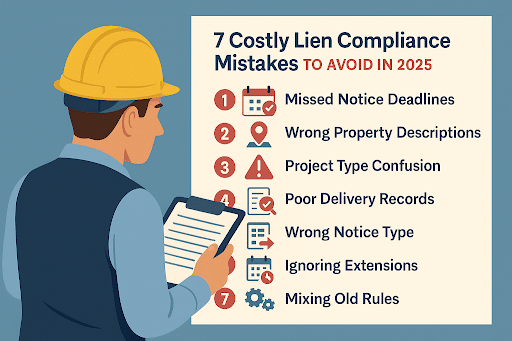
Top 7 Compliance Mistakes to Avoid in 2025
Understanding common compliance mistakes helps contractors protect their payment rights and avoid costly errors that could forfeit lien claims.
- Missing preliminary notice deadlines remains the most frequent compliance failure among subcontractors and suppliers. The monthly calculation system requires separate notices for each unpaid month, and missing any single month’s deadline forfeits lien rights for that period. Contractors should implement systems that automatically track work performance dates and calculate notice deadlines.
- Using incorrect property descriptions in lien affidavits creates issues that can void otherwise proper lien filings. Street addresses alone typically don’t provide legally sufficient identification. Contractors should obtain proper legal descriptions from county records, surveys, or title documents before filing affidavits.
- Failing to understand project classification affects deadline calculations and compliance requirements. Residential projects have different deadlines than commercial projects, and the definition of residential construction is narrower than many contractors realize. Spec homes, rental properties, and investment properties typically fall under commercial rules even if they’re single-family homes.
- Inadequate delivery documentation for required notices creates enforcement vulnerabilities. With expanded delivery options now available, contractors must ensure they maintain proper proof of delivery regardless of which method they choose. Tracking numbers, delivery confirmations, and recipient signatures all serve as important documentation.
- Confusing different notice types leads to compliance mistakes when contractors send the wrong notices or miss required notice categories. Regular labor and materials notices differ from retainage notices, which have different deadlines and content requirements. Bond claims on public projects follow entirely different procedures than mechanic’s liens.
- Ignoring weekend and holiday extensions can result in missed deadlines when contractors don’t account for the 2025 clarifications. While these extensions provide protection, contractors should understand how they apply and update their deadline tracking systems accordingly.
- Mixing old and new law requirements creates compliance issues when contractors apply outdated procedures to contracts signed after January 1, 2022. The transition period has passed, but many contractors still reference pre-2022 requirements that no longer apply to current projects.
Frequently Asked Questions
Do the 2025 changes affect contracts signed before 2025? Yes, the weekend and holiday deadline extensions from Senate Bill 929 apply to all pending lien-related actions under Chapter 53, regardless of when the original contract was signed. However, the major procedural changes from 2022 only apply to contracts signed after January 1, 2022.
What happens if I miss a deadline by one day? Texas lien law 2025 updates provide no flexibility for missed deadlines. Missing any required deadline by even one day typically results in the complete forfeiture of lien rights for that time period. The weekend and holiday extensions provide some protection, but contractors should avoid last-minute filings.
Can I use email to send required notices? No, email delivery doesn’t meet the legal requirements for lien-related notices in Texas. The law requires certified mail, personal delivery, or traceable private delivery services that can confirm receipt. Email lacks the verification and legal recognition needed for lien notices.
How do the new delivery options affect costs? Expanded delivery options like FedEx and UPS may cost more than certified mail but can provide faster delivery and more reliable tracking. Contractors should consider the total cost of compliance, including the risk of missed deadlines, when choosing delivery methods.
Do design professionals need to send preliminary notices? Yes, architects, engineers, and surveyors who don’t have direct contracts with property owners must follow the same preliminary notice requirements as subcontractors. The 2025 changes affect lien inception dates for these professionals but don’t eliminate notice requirements.
Protecting Your Payment Rights in 2025
Texas construction lien law updates for 2025 provide important clarifications while maintaining the strict compliance requirements that have always characterized lien law. The weekend and holiday extensions offer practical benefits for contractors managing complex schedules, while the delivery method expansions provide operational flexibility.
Texas Easy Lien provides user-friendly tools that guide you through lien filing, from preliminary notices to final lien affidavits, ensuring you never miss a critical deadline. Get started today and protect your right to payment with confidence. Have questions about your specific situation? Contact our team for personalized guidance.