
To file a mechanics lien in Texas, you take four steps: send the monthly notice of claim if you are a subcontractor or supplier, prepare and notarize a lien affidavit, file it with the county clerk where the property is, and send a copy to the owner within 5 days. Miss a required monthly notice or the affidavit deadline and the lien for that work is gone (53.056(a)).
Subcontractors and suppliers file the affidavit by the 15th day of the 4th month after the last month they provided labor or materials on commercial work, or the 15th day of the 3rd month on residential work. Original contractors use the same months, counted from the month their work was completed, terminated or abandoned. Retainage has its own deadlines, shown in the table below.
The rules come from Texas Property Code Chapter 53. If you first want the basics of what a lien is and who can claim one, start with What Is a Mechanics Lien in Texas?
Before You Start: Role, Project Type, Homestead and Public Work
- Your role. An original contractor has a contract directly with the owner. Everyone else who furnishes labor or materials under a contract with the contractor or a subcontractor (subcontractors at any tier and material suppliers, including makers of specially fabricated material) is a claimant other than an original contractor (53.021). The steps and deadlines depend on which one you are.
- The project type. A residential construction project is the construction or repair of a new or existing residence under a residential construction contract (53.001(10)). Every other project uses the deadlines for projects other than residential, shown as commercial below (53.052(a)(1)). See what defines a residential project if you are not sure.
- Homestead rules. If the job is the owner’s homestead, the lien needs a written contract signed before work started, signed by both spouses if the owner is married, and filed with the county clerk (53.254). Read Can You File a Lien Without a Written Contract in Texas? before you go further.
- Public or private. You cannot lien public property. On a public job you make a bond claim against the payment bond. Texas requires the prime contractor to post one on public work contracts over $25,000, or over $50,000 for a city (Government Code 2253.021).
Texas Mechanics Lien Deadlines by Role and Project Type
The monthly notice and the lien affidavit deadlines land on the 15th of a month. Subcontractors and suppliers count from the month of the unpaid work, not the day. Original contractors count from the month their work ended. When the 15th falls on a weekend or a legal holiday, the deadline moves to the next business day (53.003(e)). In November 2026 the 15th was a Sunday, so that deadline moved to Monday, November 16.
| What is due | Who sends or files it | Commercial project | Residential project | Code section |
|---|---|---|---|---|
| Notice of claim for unpaid labor or materials | Subcontractors and suppliers | 15th day of the 3rd month after each unpaid month | 15th day of the 2nd month after each unpaid month | 53.056(a-1) |
| Notice of claim for unpaid retainage | Subcontractors and suppliers with retainage in their contract | The earlier of 30 days after your contract is completed, terminated or abandoned, or 30 days after the original contract is terminated or abandoned | 53.057(a-1) | |
| Lien affidavit | Original contractor | 15th day of the 4th month after the month your work was completed, terminated or abandoned | 15th day of the 3rd month after that month | 53.052(a) |
| Lien affidavit | Subcontractors and suppliers | 15th day of the 4th month after the last month you provided labor or materials | 15th day of the 3rd month after that month | 53.052(b), (c) |
| Lien affidavit for retainage | Subcontractors and suppliers | 15th day of the 3rd month after the month the original contract was completed, terminated or abandoned | 53.052(d) | |
| Copy of the filed affidavit | Everyone who files | No later than 5 days after filing, to the owner (and the original contractor, if you are not the original contractor) | 53.055 | |
| Suit to foreclose the lien | Everyone who files | By the 1st anniversary of the last day you could have filed the affidavit | 53.158(a) | |
For more on how each deadline is counted, see How Long Do You Have to File a Lien in Texas?
How to File a Mechanics Lien in Texas: The Four Steps
Step 1: Send the Monthly Notice of Claim (Subcontractors and Suppliers)
If you did not contract directly with the owner, your lien is only valid if you sent a notice of claim for each unpaid month (53.056(a)). It goes to both the property owner and the original contractor. Texas law gives the form: it is titled “Notice of Claim for Unpaid Labor or Materials” and states the project, the work or materials you provided, who hired you and the claim amount (53.056(a-2)). You can attach your invoice (53.056(a-3)).
Contractors often call this the pre-lien notice or the notice of intent to lien. Whatever you call it, the notice that protects your lien is the one 53.056 describes, sent to both the owner and the original contractor. A separate past due letter to the general contractor is allowed but optional (53.056(a-4)).
Send every notice in person, by certified mail, or by another traceable service that confirms receipt (53.003(b)). Keep the receipts. Your lien affidavit has to list the date each notice went out and how you sent it.
Original contractors skip this step and go straight to Step 2.
Step 2: Prepare and Notarize the Lien Affidavit
The lien affidavit is the sworn document that claims the lien. Under 53.054(a) it must contain:
- A sworn statement of the amount you are owed.
- The owner’s or reputed owner’s name and last known address.
- A general statement of the work you did and the materials you furnished. Subcontractors and suppliers also list each month the unpaid work was done.
- The name and last known address of the company that hired you.
- The name and last known address of the original contractor.
- A property description that is legally sufficient to identify the property. Here is how to find the legal description on the county appraisal district site.
- Your name and mailing address, and your physical address if it is different.
- For subcontractors and suppliers, the date each notice of claim was sent and the method used.
You do not have to list every item of work or material (53.054(c)). On a homestead, the top of the affidavit must carry this line in at least 10 point bold: “NOTICE: THIS IS NOT A LIEN. THIS IS ONLY AN AFFIDAVIT CLAIMING A LIEN.” (53.254(f)).
Sign the affidavit in front of a notary. Texas Easy Lien offers an online notary, or you can use your own. Gather your contract, invoices, notice receipts and the owner’s details before you start. With those in hand, the Texas Easy Lien affidavit takes about 15 minutes.
Step 3: File the Affidavit With the County Clerk
File the signed affidavit with the county clerk in the county where the property is, not the county where your business is (53.052(e)). The clerk records and indexes it under the names of the claimant, the original contractor and the owner (53.052(e)). You pay the county recording fee when you file. Texas Easy Lien’s online filing records the affidavit with the county for you.
Keep the recording information the clerk gives you, including the document number. You will need it for the lien release later.
Step 4: Send a Copy of the Filed Affidavit Within 5 Days
No later than the 5th day after you file, send a copy of the filed affidavit to the owner at their last known business or home address. If you are not the original contractor, send a copy to the original contractor too (53.055). Use certified mail or another traceable method, and keep the proof.
A 2026 Example: Electrical Subcontractor on a Commercial Job
An electrical subcontractor works on an office build out in Austin for a general contractor. The GC has not paid for August or September 2026. September is the last month the electrician worked on the job.
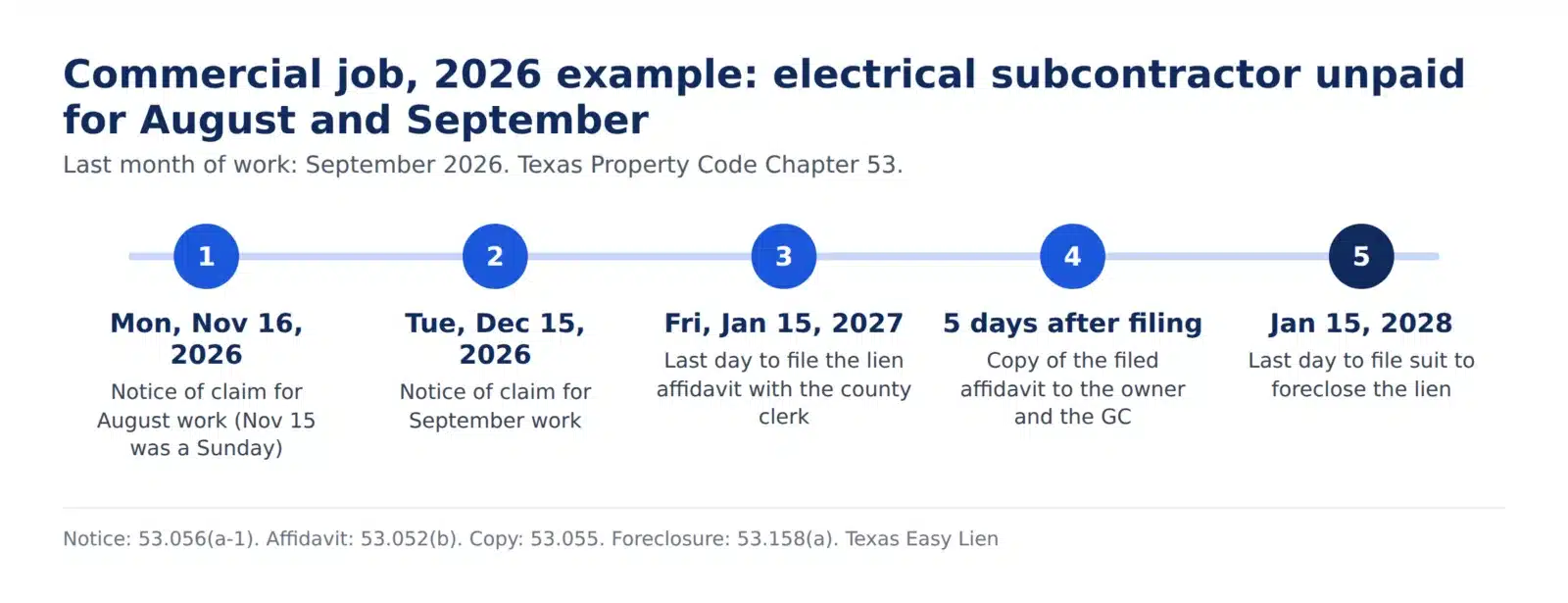
- Notice for August work: due the 15th day of the 3rd month after August, which is November 15, 2026. That was a Sunday, so the deadline moved to Monday, November 16, 2026.
- Notice for September work: due Tuesday, December 15, 2026.
- Lien affidavit: due the 15th day of the 4th month after September, Friday, January 15, 2027.
- Copy of the filed affidavit: if the electrician files on Friday, January 8, 2027, the copies to the owner and the GC go out by Wednesday, January 13, 2027.
- Suit to foreclose: by January 15, 2028, one year after the last day to file. That date is a Saturday, so 53.003(e) carries it to the next business day.
On a residential job with the same months, every date moves up a month: the September notice is due November 16, 2026 (the 15th was a Sunday) and the lien affidavit is due December 15, 2026.
How Much Does It Cost to File a Mechanics Lien in Texas?
You pay the county’s recording fee plus whatever you spend to prepare, notarize and mail the documents. County fees vary. The Harris County Clerk lists $25 for the first page and $4 for each additional page (Harris County Clerk real property fees).
With Texas Easy Lien you pay per document, with no attorney fee: the notice, the affidavit, the online notary, filing and certified mail are each listed on the pricing page. If you are weighing an attorney instead, the Texas Easy Lien vs. lawyer page compares the two.
Common Texas Filing Mistakes
- Skipping a monthly notice. A subcontractor who misses the notice for a month loses the lien for that month’s work (53.056(a)).
- Counting from the wrong date. Deadlines run from the month of the work, not the invoice date or the date the GC promised to pay.
- Filing in the wrong county. The affidavit goes to the clerk where the property is.
- Leaving out notice dates. Subcontractors and suppliers must list when and how each notice was sent.
- A loose property description. The affidavit needs a description legally sufficient to identify the property. See how to find it.
- Forgetting the 5 day copy. The copy to the owner (and the GC) is a separate requirement with its own deadline after filing (53.055).
- Signing away the lien. Read every lien waiver before you sign it. Texas law bars anyone from requiring an unconditional waiver unless you received that payment in good funds (53.283).
After You File
If you are not paid after you file, the lien is enforced through a foreclosure suit, which must be filed by the 1st anniversary of the last day you could have filed the affidavit (53.158(a)). The owner and you can extend that to two years after filing with a written agreement recorded in the county (53.158(a-2)). See How to Enforce a Construction Lien in Texas for what that involves.
When you are paid, you must furnish a lien release within 10 days after a written request (53.152(a)). The release lists the county document number from Step 3 (what a lien release needs).
Frequently Asked Questions
Can you file a mechanics lien in Texas without a lawyer?
Yes. Chapter 53 lets the person claiming the lien sign the affidavit (53.054(a)), and it does not require an attorney to prepare or file one. Texas Easy Lien is a self service platform where you answer questions about the project and the platform prepares the documents, drafted by attorneys certified in Texas construction lien law, then handles notarizing, filing and mailing.
Can I file a mechanics lien in Texas without a written contract?
On most projects, yes. Chapter 53 gives the lien to a person who works “under a contract” (53.021) and only requires a written contract on a homestead. That contract must be signed before work began, by both spouses if the owner is married, and filed with the county clerk (53.254).
What happens if I miss the deadline?
The lien for that work is not valid. A missed monthly notice costs you the lien for that month’s work, and a missed affidavit deadline costs you the lien.
Can I file a mechanics lien online in Texas?
Yes. On Texas Easy Lien you prepare the affidavit online, use the online notary or your own, and Texas Easy Lien files it with the county and sends the certified mail copies for you.
File Your Texas Mechanics Lien
Find your role and project type in the deadline table, then gather your contract, invoices and notice receipts. Texas Easy Lien prepares the notice, the lien affidavit and the release, and files and mails them for you. Create your account and start your lien.