When payment doesn’t come through on a construction project, a pre-lien notice in Texas is your first and most important step toward protecting your right to get paid. A pre-lien notice is a formal legal document that alerts the property owner and general contractor that you haven’t been paid for work you’ve performed or materials you’ve delivered. It preserves your right to file a mechanic’s lien if the payment issue isn’t resolved.
This notice goes by several names in the industry: preliminary notice, notice of intent to lien, monthly notice, fund-trapping notice, or second/third month notice. Regardless of what you call it, the legal requirement is the same under Texas Property Code Chapter 53, Section 53.056. Failing to send it by the statutory deadline, even by a single day, results in a complete waiver of your right to file a lien for that month’s work.
Who Is Required to Send a Pre-Lien Notice in Texas?

The rule is straightforward: if you do not have a direct contract with the property owner, you must send a pre-lien notice before you can file a mechanic’s lien. This applies to subcontractors, sub-subcontractors, material suppliers, equipment lessors, and laborers who work under the general contractor or another subcontractor.
General contractors (those with a direct contract with the property owner) are generally exempt from this requirement on commercial projects. However, on residential projects, the general contractor must provide the property owner with a disclosure statement and a written list of all subcontractors and suppliers before work begins. This residential disclosure requirement was updated under the legislative changes effective January 1, 2022.
In many cases, simply sending the notice is enough to prompt payment. When a property owner receives your pre-lien notice, it signals that you’re serious about protecting your rights. More importantly, it activates a legal mechanism called fund trapping that works in your favor.
How Fund Trapping Protects Your Payment
Fund trapping is one of the most powerful aspects of the pre-lien notice process, and many contractors don’t realize it exists. When a property owner receives your pre-lien notice, they gain the legal authority and obligation to withhold funds from payments to the general contractor in the amount of your claim. This means money that would otherwise flow from the owner to the GC gets held in reserve to cover what you’re owed.
This creates immediate leverage. The general contractor now has a financial incentive to resolve your payment issue because their own payments are being withheld. The property owner also has a clear record that they were notified of the unpaid claim, which protects them from paying twice for the same work.
Fund trapping doesn’t require you to file a lien. The notice alone triggers this protection. That’s why construction attorneys recommend sending the notice as standard business practice, not just when you suspect a payment problem.
Pre-Lien Notice Deadlines in Texas

Deadlines for pre-lien notices in Texas depend on two factors: your role in the project hierarchy and whether the project is residential or commercial. Missing these deadlines by even one day results in a waiver of your lien rights for that month’s work under Texas Property Code § 53.056(a-2).
| Your Role | Project Type | Deadline to Send Notice |
|---|---|---|
| Tier 1: Subcontractor or supplier working directly for the GC | Commercial (non-residential) | 15th day of the 3rd month after the month work was performed |
| Tier 1: Subcontractor or supplier working directly for the GC | Residential | 15th day of the 2nd month after the month work was performed |
| Tier 2: Sub-subcontractor or supplier working for a subcontractor | Commercial (non-residential) | 15th day of the 3rd month after the month work was performed |
| Tier 2: Sub-subcontractor or supplier working for a subcontractor | Residential | 15th day of the 2nd month after the month work was performed |
Note: under Texas Property Code §53.056(a-1), the pre-lien notice deadline is set by project type, not by your tier. House Bill 2237 removed the old second-month notice for lower-tier subcontractors effective January 1, 2022. All claimants who are not the original contractor now follow the same deadline: the 15th day of the third month on non-residential projects, the 15th day of the second month on residential.
Example: If you’re an electrical subcontractor (Tier 1) who completed work on a commercial office building in March and haven’t been paid, your pre-lien notice deadline is June 15th, which is the 15th day of the third month after March. If that same work was on a residential project, your deadline moves up to May 15th.
Critical requirement: You must send a separate pre-lien notice for each month in which you performed unpaid work. If your job spanned March, April, and May, and you weren’t paid for any of those months, you need three separate notices, each with its own deadline. Missing the deadline for one month doesn’t affect your rights for the other months, but you permanently forfeit your lien rights for any month where you didn’t send timely notice.
Not sure when your deadline is? Our platform calculates your exact deadline based on when you worked and your role in the project. Check your deadline and start your notice here.
How the Monthly Notice System Works
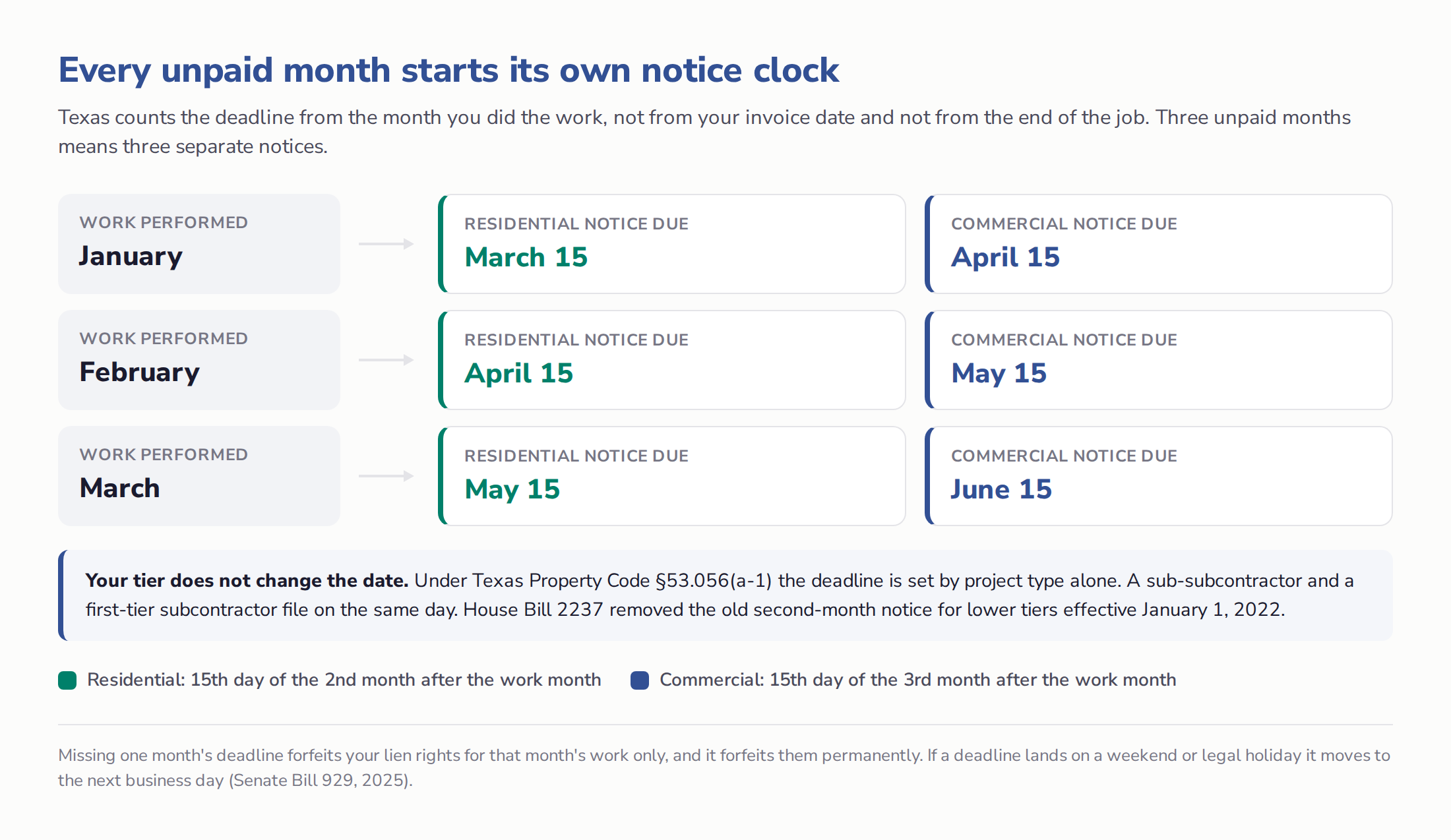
Texas counts pre-lien notice deadlines by the month in which you did the work, not by the date you invoiced and not by the date the project ended. Every unpaid month generates its own separate deadline, and each one has to be met on its own.
Track the month you performed the work or delivered the materials, then count forward from that month:
- Commercial projects. Pre-lien notice by the 15th day of the third month after the work month.
- Residential projects. Pre-lien notice by the 15th day of the second month after the work month.
If you worked in January, February, and March and were paid for none of it, that is three notices, not one. Missing the deadline for a single month forfeits your lien rights for that month’s work only, but it forfeits them permanently. There is no catching up after the date passes and no extension to ask for.
The practical consequence: calendar the deadline for each unpaid month separately, not once per project, and keep proof of mailing for every notice you send.
What Must Be Included in Your Pre-Lien Notice
A pre-lien notice is a legal document that must include specific information to be valid under Texas law. Omitting any required element could invalidate your notice and cost you your lien rights. Here is what a proper Texas pre-lien notice must contain:
- Project information: The project name, street address, and county where the work or materials were provided. This ensures there’s no confusion about which property the notice applies to.
- Your business information: Your full legal name or company name, mailing address, and a contact person. The recipient needs to know exactly who is making the claim.
- Description of work or materials: A brief, clear description of what you did or supplied. For example: “Concrete foundation work performed in March” or “Roofing materials delivered in April.”
- Names of parties involved: The property owner’s name, the general contractor’s name, and the name of the subcontractor you worked under (if applicable).
- Amount owed and applicable month: The exact unpaid amount for the specific month covered by this notice. Remember that each month requires its own separate notice.
- Statutory warning language: Your notice must include the standard legal warning required under Texas Property Code that the property could be subject to a lien if payment is not made. This language is not optional.
What Happens If You Don’t Send a Pre-Lien Notice?
The consequences are severe and immediate. If you fail to send a pre-lien notice by the statutory deadline, you permanently waive your right to file a mechanic’s lien for that month’s work. There are no extensions, no grace periods, and no exceptions. Texas courts have consistently upheld this strict deadline requirement.
Without a valid lien right, you lose your strongest leverage for collecting payment. You also lose the fund-trapping protection described above, meaning the property owner has no legal obligation to withhold funds on your behalf. You may still have a breach of contract claim against the party who hired you, but that requires litigation, which is far more expensive and time-consuming than the lien process.
The bottom line: sending a pre-lien notice on time is the single most important thing you can do to protect your payment rights on any Texas construction project where you don’t have a direct contract with the owner.
How to Send Your Pre-Lien Notice
Your pre-lien notice must be served on both the property owner and the general contractor. The most common and recommended delivery method is certified mail with return receipt requested. Under Texas law, the notice is considered served once it is deposited in the U.S. mail in proper form, so you don’t need to prove the recipient actually read it. However, keeping the certified mail receipt and the green return receipt card provides valuable proof of compliance if a dispute arises later.
The notice does not need to be notarized or filed with the county clerk. It’s served directly to the parties, not recorded in public records. For a detailed walkthrough of preparing the notice document itself, see our guide on how to prepare a notice of intent to file a lien.
Filing Online vs. DIY vs. Hiring an Attorney

You have three options for handling your pre-lien notice, each with different trade-offs in cost, speed, and accuracy:
| Method | Typical Cost | Turnaround | Accuracy | Best For |
|---|---|---|---|---|
| DIY (self-prepared) | Free + postage | Hours to days | Varies — easy to miss required elements | Experienced contractors who know the statute |
| Attorney | $200 to $500+ per notice | Days to weeks | High — but expensive for routine filings | Complex disputes or high-dollar claims |
| Online filing service | Under $100 per notice | Minutes | High — guided forms ensure compliance | Most contractors, subs, and suppliers |
Online filing platforms walk you through each required field, automatically calculate your deadline based on when the work was done and your role in the project, generate the legally compliant notice document, and handle certified mailing with tracking. This eliminates the most common mistakes that invalidate notices: missed deadlines, missing required information, and incorrect statutory language.
For a complete look at what Texas Easy Lien offers and how pricing works, visit our pricing and services page.
Frequently Asked Questions
Can a general contractor file a lien without sending a pre-lien notice?
Yes. General contractors who have a direct contract with the property owner are not required to send a pre-lien notice before filing a mechanic’s lien on commercial projects. However, on residential projects, the GC must provide a disclosure statement and subcontractor list to the property owner before work begins.
Do I need to send a separate pre-lien notice for each month of unpaid work?
Yes. Texas law requires a separate pre-lien notice for every month in which you performed work or delivered materials and were not paid. Each notice has its own deadline. Missing the deadline for one month does not affect your rights for other months.
Does a pre-lien notice need to be notarized?
No. A pre-lien notice does not need to be notarized or filed with the county clerk. It is served directly to the property owner and general contractor, typically by certified mail with return receipt requested.
What is fund trapping and how does it help me get paid?
Fund trapping is a legal mechanism triggered when the property owner receives your pre-lien notice. It gives the owner the authority and obligation to withhold funds from payments to the general contractor in the amount of your claim. This creates financial pressure on the GC to resolve your payment and often results in payment without needing to file a lien.
What are the exact deadlines for sending a pre-lien notice in Texas?
Deadlines depend on your role and project type. On commercial projects, Tier 1 claimants (those working directly for the GC) must send notice by the 15th day of the third month after the work month. On residential projects, the deadline is the 15th day of the second month. Tier 2 claimants (those working for a subcontractor) follow the second-month deadline on both project types. Missing a deadline by even one day permanently waives your lien rights for that month.
Have more questions about the lien deadlines by project type? Or ready to protect your lien rights? Get started with Texas Easy Lien.