
Key Takeaways
Filling out a Texas mechanics lien form correctly is the difference between getting paid and losing your claim entirely.
- The Texas mechanics lien form, officially called a lien affidavit, has specific required fields that must be complete or the lien can be thrown out
- Deadlines are strict and vary depending on whether you are a general contractor, subcontractor, or supplier, and whether the project is commercial or residential
- A notarized signature is required before the form can be filed with the county clerk
- Missing a single deadline or field can cost you thousands in unpaid work
If you are owed money on a Texas construction project, getting your lien form right the first time is critical. There are no do-overs once the deadline passes.
SKIP THE FORM HEADACHES AND FILE YOUR TEXAS LIEN ONLINE
Filling out a Texas mechanic’s lien form incorrectly can get your claim rejected or invalidated. Texas Easy Lien generates a properly completed, deadline-ready lien document for your specific situation.
Start Your Lien FilingTexas construction payment problems are far more common than most contractors want to think about. According to Rabbet’s 2024 Construction Payments Report, 82% of contractors now face payment waits exceeding 30 days, and slow payments cost the U.S. construction industry an estimated $280 billion in 2024 alone. The mechanics lien is the most powerful legal tool you have to force the issue, but only if you fill out your Texas mechanics lien form correctly.
A lot of contractors understand that they can file a lien but get tripped up on the details of how to do it. The form itself, called a lien affidavit under Texas law, has to contain specific information in the right format, be signed in front of a notary, and be filed on time. Miss any of those steps and your claim is gone. This guide walks you through everything you need to know about the Texas mechanics lien process, from the required fields to the filing deadlines to what happens after you submit.
What Is a Texas Mechanics Lien Form?
The Texas mechanics lien form is a legal document, formally called a mechanic’s and materialman’s lien affidavit, that allows contractors, subcontractors, and suppliers to place a claim against a property when they haven’t been paid for work or materials. Once filed, the lien attaches to the property title, which means the owner typically can’t sell or refinance the property without resolving the unpaid debt first.
The authority for this form comes from Chapter 53 of the Texas Property Code, which lays out exactly who can file, what must be included in the affidavit, and when it must be filed. Texas lien law is detailed and deadline-driven, so understanding the form is not optional. It is the foundation of your ability to get paid.
A Texas mechanics lien is not a lawsuit. It is a recorded document that creates a security interest in the property. The goal is to protect your payment rights and create enough leverage that the owner or general contractor resolves what’s owed before the situation escalates further.
Who Can File a Texas Mechanics Lien Form?
Texas lien law gives filing rights to a wide range of construction professionals. Under Chapter 53 of the Texas Property Code, the following parties are generally eligible to file a Texas mechanics lien:
- General contractors (original contractors with a direct contract with the property owner)
- Subcontractors (first-tier subs who contract with the GC)
- Sub-subcontractors (second-tier subs who contract with a first-tier sub)
- Material suppliers who furnish materials for a Texas construction project
- Equipment rental companies supplying equipment used on the project
- Design professionals, including licensed architects, engineers, and surveyors
- Laborers who performed work on the project
Your role in the project matters because it determines your specific deadlines and whether you need to send a pre-lien notice before filing. General contractors who have a direct contract with the property owner are not required to send a pre-lien notice. Subcontractors, sub-subs, and suppliers generally are, and skipping that step eliminates your right to file a lien for the affected month’s work.

What Information Goes on a Texas Mechanics Lien Form?
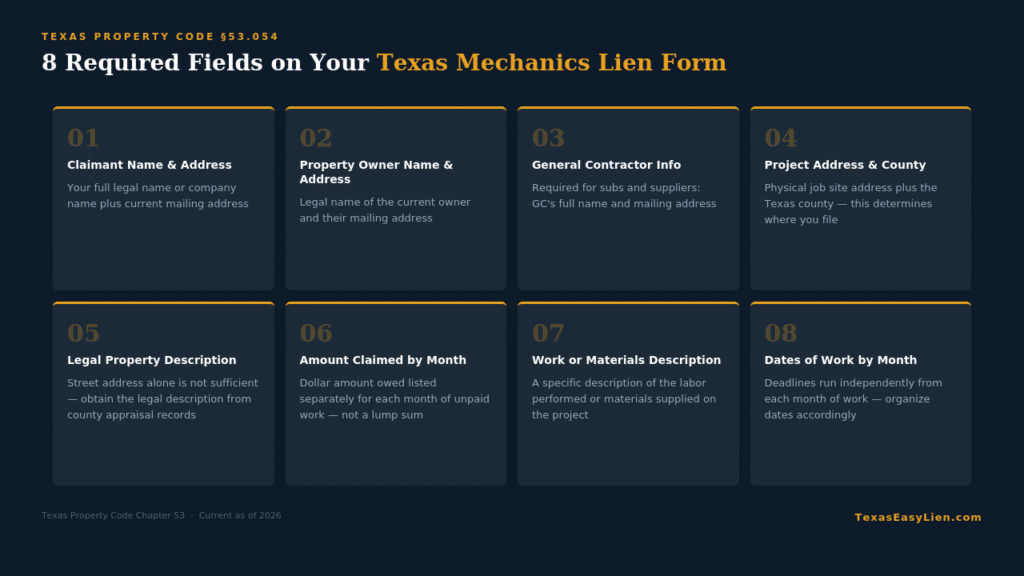
This is where a lot of contractors run into trouble. The Texas mechanics lien form goes well beyond a one-page document where you write down what you’re owed. It requires specific identifying information about the project, the parties involved, and the work performed. Under Texas Property Code §53.054, a valid lien affidavit must include all of the following:
Required Fields on the Texas Mechanics Lien Affidavit
Here is what you will need to complete your Texas mechanics lien form:
- Claimant’s name and address: Your full legal name (or your company’s legal name) and mailing address
- Property owner’s name and address: The legal name of the current property owner and their mailing address
- General contractor’s name and address: Required if you are a subcontractor or sub-subcontractor; this is the name and address of the prime contractor on the job
- Project address and county: The physical address of the project and the Texas county where it is located, since this determines where you file
- Legal description of the property: The street address alone is insufficient; Texas requires the legal property description from official records
- Amount claimed: The specific dollar amount owed for each month in which work was performed or materials were supplied
- Description of the work or materials: A brief but specific description of what you did or supplied
- Dates work was performed or materials delivered: Broken down by month, because lien deadlines run on a month-by-month basis
One point that trips up many contractors: the amount claimed must be broken out by month, not listed as a single lump sum. If you worked for three months without being paid, you need to identify the amount owed for each individual month separately. This is because the filing deadlines run from each month of unpaid work independently of the others.
The legal description of the property can be found through your county’s appraisal district records. If you are not sure how to find it, Texas county appraisal district offices are listed on the Texas Comptroller’s website and most offer free online property search tools.
What Are the Deadlines for Filing Your Texas Mechanics Lien Form?
Texas lien deadlines are non-negotiable. Miss them and you lose your lien rights for that period of work, with no exceptions and no ability to fix it after the fact. The deadlines vary based on your role in the project and whether the job is commercial or residential.
Senate Bill 929, signed into law on May 21, 2025, clarified that any lien-related deadline falling on a Saturday, Sunday, or legal holiday automatically extends to the next business day. This eliminates a long-standing source of confusion and gives contractors clearer ground to stand on when deadlines land on weekends.
Commercial Projects
For subcontractors and suppliers on commercial projects, the timeline runs from the month in which work was performed:
- Invoice due: By the 15th of the 2nd month following the month of unpaid work
- Pre-lien notice due: By the 15th of the 3rd month following the month of unpaid work
- Lien affidavit due: By the 15th of the 4th month following the month of unpaid work
For general contractors on commercial projects, the lien affidavit must be filed by the 15th day of the 4th month after completion, termination, or abandonment of the contract.
Residential Projects
Timelines are tighter on residential projects, which cover owner-occupied single-family homes, duplexes, triplexes, and quadruplexes:
- Subcontractors: Pre-lien notice by the 15th of the 2nd month; lien affidavit by the 15th of the 3rd month
- General contractors: Lien affidavit by the 15th of the 3rd month after completion, termination, or abandonment
For a detailed breakdown with real-date examples, see this guide to Texas mechanics lien deadlines and timelines.

What Common Mistakes Can Void Your Texas Mechanics Lien?
Filling out the form incorrectly is one of the most common ways contractors permanently lose their lien rights in Texas. The following mistakes cause the most problems and are entirely avoidable with the right preparation.
Using the wrong property description. The street address alone is not sufficient. Texas requires the legal description of the property from official records, and relying only on a street address can result in the lien being challenged or rejected at the county clerk’s office.
Missing the monthly breakdown. Listing a single lump sum without separating amounts by month of work performed is a common error. Each month’s unpaid work is a separate claim with its own deadline, and lumping them together creates serious compliance problems.
Forgetting to send the pre-lien notice first. Subcontractors and suppliers who skip the pre-lien notice requirement cannot file a valid lien affidavit for that month’s work. The notice can be sent the same day as the lien filing as long as all deadlines are met, but it cannot be skipped entirely.
Filing in the wrong county. The lien must be filed with the county clerk in the county where the property is physically located. Filing in any other county renders the lien ineffective under Texas law.
Missing the notarization. A Texas mechanics lien form that is not properly notarized will be rejected. The signature must be acknowledged before a licensed notary public before the document is submitted.
Missing the post-filing notice deadline. After the lien affidavit is recorded, you must serve a copy on the property owner and the general contractor within five calendar days. This step is absolute. Missing it invalidates the entire lien claim, regardless of how correctly everything else was handled.
Waiting too long. Because Texas lien deadlines run from each month of unpaid work rather than from an invoice date or payment due date, contractors often realize too late that the window has already closed.
Does Your Texas Mechanics Lien Form Need to Be Notarized?
Yes. Under Texas law, a lien affidavit must be notarized before it can be filed with the county clerk. The claimant, or an authorized representative of the company, must sign the document in the presence of a licensed notary public, who then applies their official seal and commission information.
This requirement exists because a lien affidavit is a sworn statement. You are attesting under oath that the information in the document is accurate and that the claimed amount is legitimately owed. Submitting false information in a lien affidavit carries legal consequences, including potential liability under the Texas fraudulent lien statute, so the notarization step protects the integrity of the process for all parties.
Traditionally, notarization meant scheduling a trip to a bank, shipping store, or government office and signing in person. Texas now allows remote online notarization (RON), which lets you complete the notarization via a secure video call with a commissioned notary. This can be done from your phone or laptop at any time of day, which is a major practical benefit for contractors who can’t easily take time off the job site.
For more on how notarization fits into the overall process, see this full step-by-step mechanics lien filing guide.
What Happens After You File the Texas Mechanics Lien Form?
Once your lien affidavit is recorded with the county clerk, the lien attaches to the property’s title record. At that point, the property owner is on official notice, and so are any title companies, lenders, or potential buyers who run a title search on the property. Most owners move quickly to resolve a recorded lien rather than have it block a pending sale or refinancing transaction.
After filing, you have exactly five calendar days to serve a copy of the filed lien affidavit on the property owner and the general contractor. This deadline is hard and absolute. Missing it invalidates the entire lien claim regardless of how correctly the rest of the process was handled.
In many cases, filing the lien, or even sending the pre-lien notice, is enough to prompt payment. The presence of a lien on the title creates real financial pressure that most owners and developers want to eliminate quickly. If payment still does not come through, the next step is enforcement through a lawsuit. Under Texas Property Code §53.158 as amended by House Bill 2237, lien claimants on projects with contracts entered into on or after January 1, 2022 generally have one year from the last date they could have filed the lien affidavit to bring a foreclosure action. Missing that one-year window means the lien expires and the legal remedy to force a sale is gone.
If you receive payment after filing, you are required to file a lien release with the same county clerk’s office to remove the claim from the property record. Keeping a lien on the record after payment has been received can expose you to legal liability and damage business relationships, so the release should be filed without delay.
Understanding the full lifecycle of a Texas mechanics lien, from pre-lien notice through recording, post-filing notice, and eventual release, puts you in the strongest possible position to collect what you have earned without the process spiraling into lengthy litigation.

Quick Summary: Texas Mechanics Lien Form Checklist
Before you file, run through these requirements to confirm your Texas mechanics lien form is complete and correct:
- Full legal name and address of the claimant (you or your company)
- Full legal name and address of the property owner
- Name and address of the general contractor (if you are a sub or supplier)
- Physical project address and the Texas county where it is located
- Legal property description obtained from official county appraisal district records
- Dollar amount claimed, separated by month of unpaid work
- Clear description of the work performed or materials supplied
- Dates of work or material delivery, organized by month
- Pre-lien notice sent on time (if required based on your role and project type)
- Notarized signature from the claimant or authorized representative
- Filed with the correct county clerk by the applicable deadline
- Copy served on property owner and GC within five calendar days of filing
Frequently Asked Questions: Texas Mechanics Lien Form
Can I file a Texas mechanics lien form if the customer just refuses to pay? Yes. A mechanics lien is available whenever you have performed work or supplied materials for which you have not been paid, regardless of the reason the owner gives for withholding payment. The key requirements are that the work was performed, the payment is legitimately owed, and you have met all applicable notice and filing deadlines.
What if I don’t know the legal description of the property? The legal description can be found through the county appraisal district where the property is located. Most Texas counties provide free online property search tools through their appraisal district websites. Many online lien filing platforms also include access to statewide property databases so you can locate the description during the document preparation process.
Do I need a lawyer to fill out a Texas mechanics lien form? No. Texas law does not require you to hire an attorney to file a mechanics lien. Contractors complete and file their own lien affidavits regularly, particularly when using an online platform designed to walk them through each required field step by step.
What is the difference between a commercial and residential lien in Texas? The main differences are the deadlines and, in some cases, the required notices. Residential projects have compressed filing windows, and the definition of residential under Texas law is specific. It covers owner-occupied single-family homes, duplexes, triplexes, and quadruplexes. Spec homes under construction that are not yet owner-occupied are treated as commercial projects for lien purposes, which gives contractors more time.
Does filing a lien guarantee I will get paid? No. A lien creates a legal claim against the property and gives you significant leverage to pursue payment, but it does not automatically result in collection. If the owner does not pay after a lien is filed, you may need to enforce the lien through a legal proceeding, and that must happen within the one-year enforcement window under current Texas law.
Get Your Texas Mechanics Lien Form Right the First Time
There is no room for error when it comes to a Texas mechanics lien form. The required fields, the notarization, the post-filing notice, the deadlines: all of it has to come together correctly, or you risk losing the one legal tool that gives you real leverage to collect what you have earned.
The good news is that you do not have to navigate this alone or pay attorney fees to get it done. Texas Easy Lien was built specifically for contractors, subcontractors, and suppliers who need to protect their payment rights without the cost or complexity of hiring a lawyer. The platform guides you through every required field, connects you with remote online notarization, handles filing, and keeps track of your deadlines, all from your phone or computer, often in 15 minutes or less. When you are ready to protect your right to get paid, start your claim with Texas Easy Lien today.
LET TEXAS EASY LIEN HANDLE YOUR MECHANIC’S LIEN FORM AND FILING
You don’t need to figure out every field on your own. Texas Easy Lien walks you through the process, prepares your Texas lien form correctly, and gets it filed before your deadline.
Start Your Lien Filing