When you’ve done the work but haven’t been paid, knowing how to put a lien on a property in Texas can be the difference between getting your money and eating the loss. A mechanic’s lien gives you a legal claim against the property until you’re paid, preventing the owner from selling, refinancing, or transferring the property until your debt is resolved. It’s the most powerful tool contractors have to secure payment under Texas Property Code Chapter 53.
The construction industry lost $280 billion to slow and non-payment in recent years, and 82% of contractors now experience payment delays exceeding 30 days. Texas law provides strong protections for contractors, subcontractors, and suppliers through the mechanic’s lien process, but the requirements are strict. A single missed deadline, incorrect property description, or failure to send proper notices can completely invalidate your lien and cost you thousands in unpaid invoices.
This guide walks through every step of the Texas lien process, from confirming your eligibility through filing and enforcement, including the homestead property requirements that trip up many contractors.
Who Can File a Lien on Property in Texas?
Not everyone who works on a construction project can file a mechanic’s lien. Under Texas Property Code § 53.021, the following parties are eligible: general contractors, subcontractors, sub-subcontractors, material suppliers, equipment lessors, architects, engineers, surveyors, landscapers, and demolition crews who provide labor, materials, or services that improve a privately owned property.
You cannot file a mechanic’s lien against property owned by a public entity (state, county, municipality, or city). For public projects where the prime contract exceeds $25,000, the general contractor is required to purchase a payment bond. If you haven’t been paid on a public project, your remedy is a bond claim rather than a lien.
Texas does not require a written contract for most mechanic’s lien claims. Verbal agreements and contracts implied through conduct are sufficient. However, there are three important exceptions where written contracts are mandatory: homestead properties, design professionals (architects, engineers, and surveyors), and landscaping installation work.
Types of Property Liens in Texas
A mechanic’s lien is one of several kinds of lien that can attach to Texas property. Knowing which type you are dealing with matters, because the rules, the deadlines, and the order of payment are different for each.
Texas liens fall into two broad categories. Voluntary liens are ones the property owner agrees to, almost always as part of a financing arrangement. A mortgage or deed of trust is the common example: the owner signs, the lender funds, and the lien secures repayment. Involuntary liens attach without the owner’s consent, usually because of an unpaid debt or a court judgment. Tax liens, judgment liens, HOA assessment liens, and mechanic’s liens all fall in this group. Owners frequently do not discover an involuntary lien until they try to sell or refinance.
Which Lien Gets Paid First
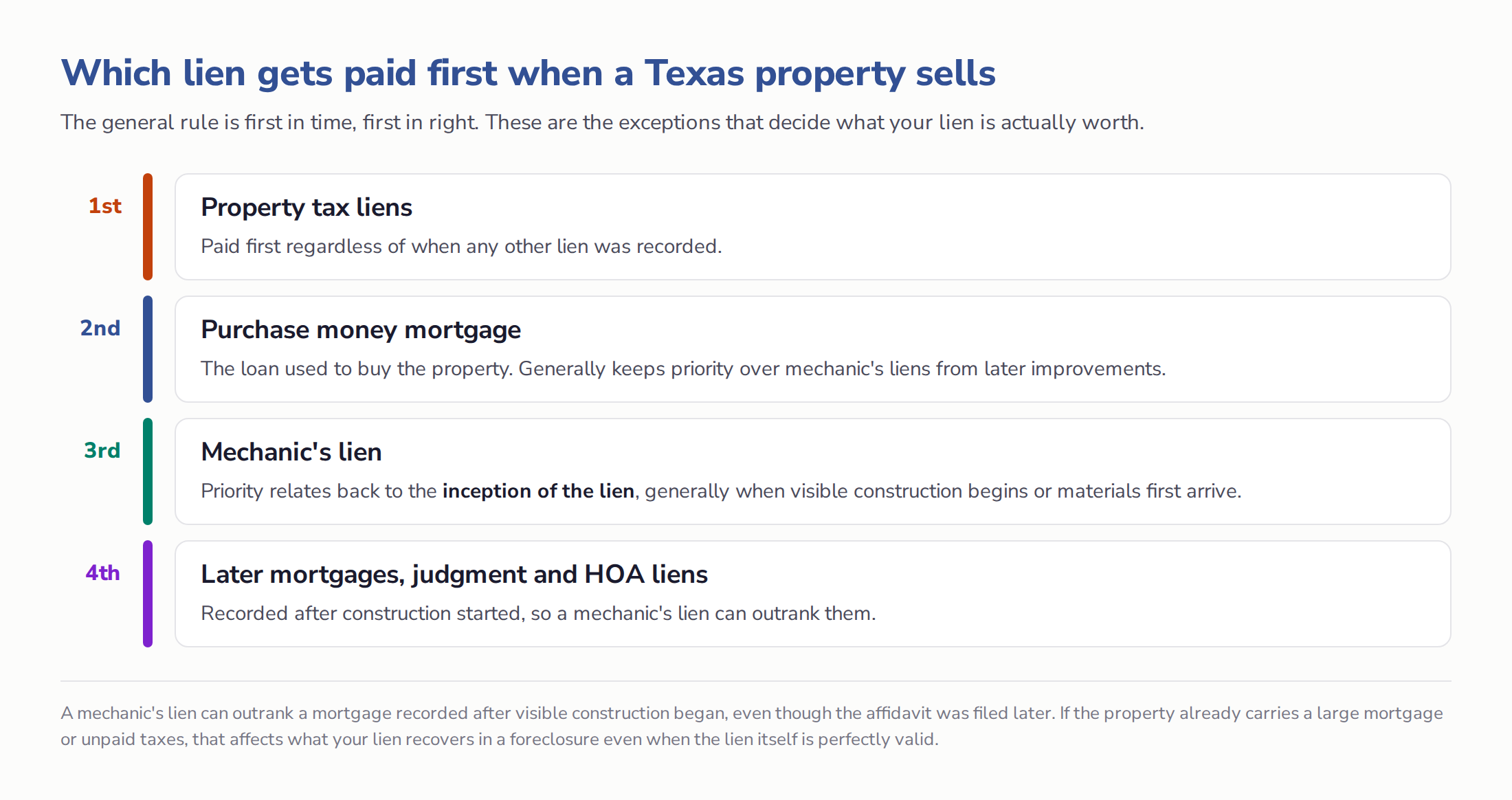
Lien priority decides who gets paid when a property is sold or foreclosed. The general rule is first in time, first in right: a lien recorded earlier outranks one recorded later. Several exceptions matter to contractors.
- Property tax liens generally take first priority no matter when other liens were recorded.
- Mechanic’s liens get special treatment. Priority relates back to the inception of the lien, which is generally when visible construction begins or materials first arrive on site. That means a mechanic’s lien can outrank a mortgage recorded after construction started, even though the lien affidavit was filed later.
- Purchase money mortgages, meaning the loan used to buy the property, generally keep priority over mechanic’s liens arising from later improvements.
If a property already carries a large mortgage or unpaid taxes, that affects what your lien is actually worth in a foreclosure, even when the lien itself is valid.
Constitutional Liens vs. Statutory Liens
Texas recognizes two kinds of mechanic’s lien, and which one you have depends on your relationship to the property owner.
Constitutional liens are sometimes called self-executing. They attach to the property automatically when work begins, with no paperwork required for the lien to exist. They generally protect only parties with a direct contract with the property owner, such as original contractors and some suppliers. Even though the lien attaches automatically, you still have to file a lien affidavit to enforce it in court.
Statutory liens are created by Chapter 53 of the Texas Property Code and require you to follow the procedure exactly, including pre-lien notices and filing deadlines. Statutory liens cover a much broader group, including subcontractors and suppliers who have no direct contract with the owner.
Most subcontractors and suppliers are relying on statutory lien rights. If that is you, the notice and filing deadlines below are not optional details. They are the whole of your claim.
Lien Filing Deadlines in Texas
Missing a lien deadline in Texas permanently forfeits your payment rights. All deadlines are calculated from your last day of work or delivery of materials, not from invoice dates or payment due dates. The specific deadline depends on your role in the project and whether the project is residential or commercial.
| Role / Project Type | Pre-Lien Notice Deadline | Lien Affidavit Filing Deadline |
| Original Contractor – Commercial | None required | 15th day of the 4th month after completion, termination, or abandonment |
| Original Contractor – Residential | None required | 15th day of the 3rd month after completion, termination, or abandonment |
| Subcontractor / Supplier – Commercial | 15th day of the 3rd month after each unpaid month | 15th day of the 4th month after last work or delivery |
| Subcontractor / Supplier – Residential | 15th day of the 2nd month after each unpaid month | 15th day of the 3rd month after last work or delivery |
| Retainage Claims | Included in contract or monthly notices | 15th day of the 3rd month after original contract completion |

Example: If you’re a plumbing subcontractor who last worked on a commercial office building on March 20, your pre-lien notice deadline is June 15 (15th day of the 3rd month after March), and your lien affidavit filing deadline is July 15 (15th day of the 4th month). If the same work was on a residential project, those deadlines move up by one month.
If a deadline falls on a weekend or state holiday, it extends to the next business day. This flexibility was added in the legislative changes effective January 1, 2022.
5 Steps to Put a Lien on a Property in Texas
If you’re wondering how to put a lien on property in Texas, here’s the process broken into clear steps. These rules come directly from the Texas Property Code and apply whether you need to put a lien on a house or a commercial project.
Step 1: Confirm you qualify
Verify that you meet the eligibility requirements listed above. Confirm the property is privately owned (not government property). If the project is on a homestead property, confirm you have a written contract that meets the additional requirements discussed in the homestead section below.
Step 2: Send required pre-lien notices
If you’re a subcontractor, sub-subcontractor, or supplier (anyone without a direct contract with the property owner), you must send a pre-lien notice to the property owner and general contractor before filing a lien. This notice must be sent by certified mail with return receipt requested for each month of unpaid work, by the deadline shown in the table above.
The pre-lien notice must include the project name and address, your business information, a description of the work performed, the amount owed, and the statutory warning language required under Texas Property Code § 53.056. For a detailed guide on this step, see our walkthrough on pre-lien notices in Texas, and how to prepare a notice of intent to lien in less than an hour.
General contractors with a direct contract with the property owner are not required to send pre-lien notices on commercial projects. However, on residential projects, the GC must provide a disclosure statement and subcontractor list to the property owner before work begins.
In many cases, simply sending the pre-lien notice is enough to prompt payment. The notice activates a legal mechanism called fund trapping that gives the property owner authority to withhold funds from the general contractor on your behalf.
Step 3: Prepare and file the lien affidavit with the county clerk
The lien affidavit is the formal legal document that creates your claim against the property. Under Texas Property Code § 53.052, the affidavit must be signed under oath, notarized, and include the following information:
- The name and address of the property owner
- A general description of the work performed or materials delivered
- The total amount of your unpaid claim
- The legal description of the property (not just the street address)
- The name and address of the original contractor
- A statement that you provided labor, materials, or services for the project
The legal description must come from the county clerk’s property records or the deed, not from your contract or the project address. An incorrect property description can invalidate your lien. Many counties offer online property record searches where you can verify the legal description before filing. Texas Easy Lien includes a statewide property database that lets you verify the real property owner’s information and legal description during the filing process at no extra cost.
Take the completed, notarized affidavit to the county clerk’s office in the county where the property is located. Some counties accept electronic filing through approved services. Filing fees vary by county, typically ranging from $25 to $50. You’ll receive a stamped copy showing the lien has been recorded in the public records.
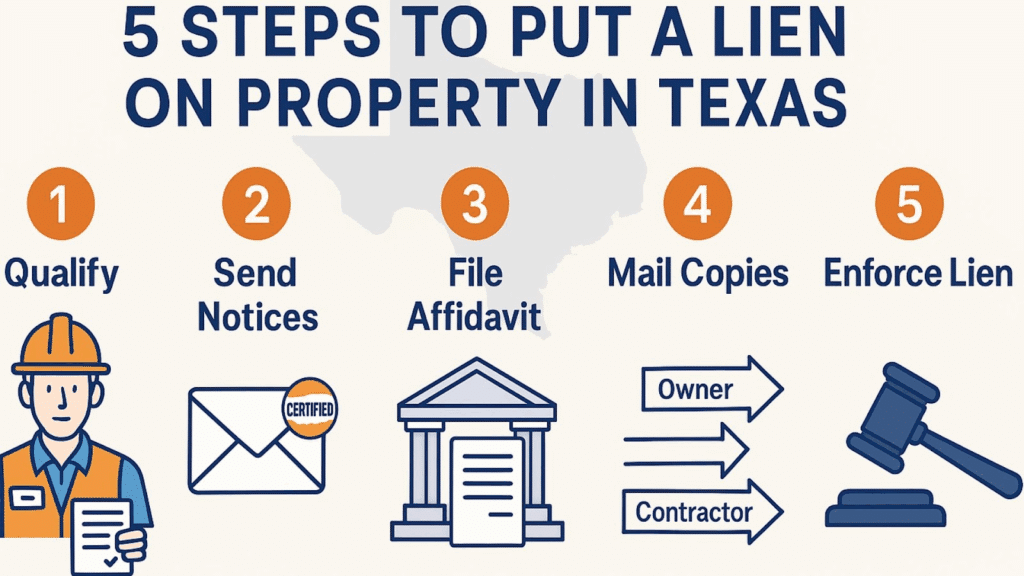
Step 4: Send copies of the filed lien affidavit
Within five days of filing the lien affidavit with the county clerk, you must mail a copy to the property owner at their last known address. If you’re not the original contractor, you must also mail a copy to the original contractor. This is a separate requirement from the pre-lien notice and must be completed within the five-day window or your lien may be challenged.
Send copies by certified mail with return receipt requested and keep the mailing receipts as proof of compliance. In the case of Wesco Distribution v. Westport Group (Tex. App.—Austin, 2004), a subcontractor lost lien rights because the pre-lien notice was mailed with insufficient postage. Delivery method matters.
Step 5: Enforce your lien if necessary
Filing a lien creates leverage, and in many cases the property owner will resolve the debt to clear the title. But if payment doesn’t come, you must file a lawsuit to foreclose on the lien within specific timeframes. Under Texas Property Code § 53.158, the lawsuit must be filed no later than one year after the last day the lien could have been filed, or within one year after the completion, termination, or abandonment of the original contract, whichever is later.
If you don’t file suit within this timeframe, the lien becomes unenforceable. If you prevail in foreclosure, you may be entitled to recover reasonable attorney’s fees and costs in addition to the unpaid amount.
Not sure about your deadlines or ready to start? See our pricing and start your lien filing here.
Special Requirements for Homestead Properties
Filing a lien on a homestead property (the owner’s primary residence) in Texas involves additional requirements that don’t apply to commercial projects. Failing to meet these requirements will destroy your lien rights entirely, regardless of how much you’re owed.
Under Article XVI, Section 50 of the Texas Constitution and Texas Property Code § 53.254, the following conditions must be met for homestead projects:
- Written contract required. The original contractor must have a written contract with the property owner. Oral or implied contracts are not sufficient for homestead properties.
- Both spouses must sign. If the property owner is married, both spouses must sign the contract, even if only one spouse owns the property.
- Contract must be filed with the county clerk. The written contract must be filed with the county clerk before work begins. If the GC fails to file the contract, derivative claimants (subcontractors and suppliers) typically cannot confirm whether they have lien rights until the lien process is already underway.
- Special warning language. The lien affidavit for homestead properties must include the notice: “NOTICE: THIS IS NOT A LIEN. THIS IS ONLY AN AFFIDAVIT CLAIMING A LIEN.” in 10-point bold font at the top of the document.
These requirements exist because Texas homestead protections are among the strongest in the country. If you’re unsure whether a property qualifies as a homestead, check the county appraisal district records for the homestead exemption status before starting work.
Public Projects: File a Bond Claim, Not a Lien
You cannot place a mechanic’s lien on government owned property. A school, a city building, a state facility, or a municipal project is not lienable, no matter how much you are owed.
You are not out of options. Public projects in Texas generally require the prime contractor to carry a payment bond, and an unpaid subcontractor or supplier files a claim against that bond instead. It is a different process from a mechanic’s lien, with its own notice requirements and deadlines, but it serves the same purpose. Bond claims are often resolved faster than liens, because surety companies have a business reason to settle valid claims promptly.
Confirm who owns the property before you start the lien process. Filing a lien against public property costs you time you may not have and does nothing to secure payment.
What Happens After You File a Lien?
Once your lien is filed and recorded, it creates a cloud on the property’s title. This means the property cannot be sold, refinanced, or transferred with clean title until the lien is resolved. In most cases, this creates immediate pressure for the property owner to address the debt.

If you timely and properly file your lien, you gain several additional rights under the Texas Property Code: the right to file a lawsuit to foreclose and force a sale of the property, a lien against any funds held by the property owner and due to the general contractor, and the right to be paid directly by the property owner if the general contractor doesn’t dispute the amount in writing. If the property owner pays the general contractor after receiving a timely pre-lien notice with fund-trapping language, you may even have the right to force the property owner to pay twice for your work.
How to Release a Lien After Getting Paid
Once you receive full payment, you are legally required to release the lien. Failing to do so can result in liability for damages to the property owner. The release must be filed with the same county clerk where the original lien was recorded.
Texas law requires lien waivers and releases to follow specific statutory forms. For contracts entered into on or after January 1, 2022, notarization is no longer required for lien waivers, but the waiver must use the statutory form to be valid and enforceable. For more on the differences, see our guide to construction lien waivers.
Records to Keep Before You File
Every deadline in this process runs from your last day of work or last delivery of materials, not from the date you invoiced. That single fact is why record keeping decides most lien claims. Keep the following from the start of the job:
- Work and delivery dates. The dates that set your deadlines.
- The contract and any change orders. Signed where possible.
- Invoices, receipts, and payment records. Including partial payments and the balance still owed.
- Proof of every notice sent. Certified mail receipts, the address used, and the date.
- Project communications. Emails, texts, and notes from calls, particularly anything about scope changes or payment problems.
- Site photographs. Dated where you can.
Good records do two things: they let you complete the affidavit quickly and accurately when the clock is running, and they give you evidence if the owner challenges the lien later. Build in buffer time as well. County offices keep limited hours and electronic filing systems go down, so filing several days before your deadline is worth the effort.
Common Mistakes That Invalidate Liens
Studies suggest that a significant percentage of mechanic’s lien attempts fail due to procedural errors. The most common mistakes include:
- Missed deadlines. Filing even one day late permanently forfeits your lien rights for the affected work period. This is the single most common reason liens fail.
- Incorrect legal description. Using the street address instead of the official legal description from county records. The legal description must match what appears in the deed.
- Failed pre-lien notices. Subcontractors and suppliers who skip the pre-lien notice step or mail it with improper delivery (insufficient postage, wrong address, not certified mail) lose their right to file a lien entirely.
- Missing homestead requirements. Working on a homestead property without a written contract signed by both spouses and filed with the county clerk before work begins.
- Not notarizing the affidavit. Texas requires all lien affidavits to be notarized. Signing the affidavit before meeting with the notary invalidates the notarization.
- Failing to mail copies after filing. Not mailing copies of the filed lien affidavit to the property owner and contractor within five days of filing.
How Much Does It Cost to Put a Lien on a Property in Texas?

The cost of filing a lien in Texas depends on which approach you take:
| Method | Typical Cost | What You Get |
|---|---|---|
| DIY (self-prepared) | $25 to $50 (county filing fees only) | You handle all preparation, notarization, and mailing yourself |
| Attorney | $300 to $1,000+ | Full legal preparation and filing, legal advice on enforcement |
| Online filing service | Under $100 + filing fees | Guided preparation, deadline tracking, notarization, and filing |
For straightforward lien filings, an online service offers the best balance of cost, speed, and accuracy. Attorney representation makes more sense for complex disputes, high-dollar claims, or situations involving homestead properties where the legal requirements are more demanding.
Texas Easy Lien walks you through each required field, verifies your property information against county records, calculates your exact deadlines, and handles notarization and certified mailing. See our pricing and services.
Frequently Asked Questions
Can I file a lien without a written contract in Texas?
Yes, in most cases. Texas law protects contractors who provide labor or materials based on oral agreements or agreements implied through conduct. However, written contracts are mandatory for homestead properties, design professionals (architects, engineers, surveyors), and landscaping installation work.
How long does a lien stay on property in Texas?
A lien remains on the property until it’s released or you fail to enforce it. Under Texas Property Code § 53.158, you must file a lawsuit to foreclose on the lien within one year of the last day you could have filed the lien, or within one year after the original contract is completed, terminated, or abandoned, whichever is later. If you don’t file suit within this period, the lien becomes unenforceable.
Can a property owner remove a lien without paying?
A property owner can challenge a lien in court if they believe it’s invalid due to missed deadlines, incorrect procedures, or other legal defects. They can also post a bond to have the lien removed from the property title while disputing the underlying debt. If the lien is found to be fraudulent, the property owner may recover damages from the lien claimant.
What is the difference between a pre-lien notice and a mechanic’s lien?
A pre-lien notice is a required warning sent before filing a lien. It informs the property owner about unpaid amounts and activates fund-trapping rights. A mechanic’s lien is the actual legal claim filed against the property after non-payment. Subcontractors and suppliers must send the pre-lien notice before they can file the lien.
Can I put a lien on a house (residential property) in Texas?
Yes, but residential properties, especially homestead properties, have stricter requirements and shorter deadlines. The original contractor must have a written contract signed by both spouses (if married) and filed with the county clerk before work begins. The lien affidavit must also include specific warning language. See the homestead section above for full details.
How much does it cost to put a lien on a property in Texas?
County filing fees typically range from $25 to $50. If you use an online filing service, total costs are generally under $100 plus filing fees. Attorney fees for lien filing range from $300 to $1,000 or more depending on complexity. See the cost comparison table above for a detailed breakdown.
Ready to protect your right to payment? Texas Easy Lien simplifies the entire lien process, from calculating your deadlines to preparing and filing your documents. Get started with Texas Easy Lien.