Choosing the wrong payment tool in Texas construction can cost you everything — lien rights exist only on private projects, and bond claims are your sole remedy on public ones.
- A mechanics lien attaches to private property; you cannot lien government-owned property in Texas.
- Bond claims are the legal substitute for subcontractors and suppliers on public works projects.
- Deadlines for both tools fall on the 15th of the month and are strict — missing one can permanently forfeit your right to payment.
- Understanding which tool applies before you start a project is the single most important step in protecting your payment rights.
Bottom line: The first question to ask when you haven’t been paid is simple — is the property owned by a government entity, or a private party? Your answer determines your entire strategy.
Getting stiffed on a construction job is one of the most frustrating experiences in this industry. You did the work, you delivered the materials, and now the money isn’t coming. The good news is Texas law gives you real tools to fight back. The problem is, most contractors don’t realize there are two completely different tools — and using the wrong one does nothing to protect you. Understanding the difference between a Texas lien vs. bond claim is the first and most critical step in getting paid.
Payment problems in construction are widespread. According to Rabbet’s 2024 Construction Payments Report, slow payments cost the U.S. construction sector an estimated $280 billion in 2024 alone, and 82% of contractors are now waiting more than 30 days to get paid. For Texas contractors especially, knowing which legal remedy applies to your specific job can be the difference between getting paid and getting nothing.
This guide breaks down the Texas lien vs. bond claim distinction clearly, so you know exactly which one applies to your project, who qualifies, and what deadlines you need to hit.
What Is the Difference Between a Texas Lien vs. Bond Claim?
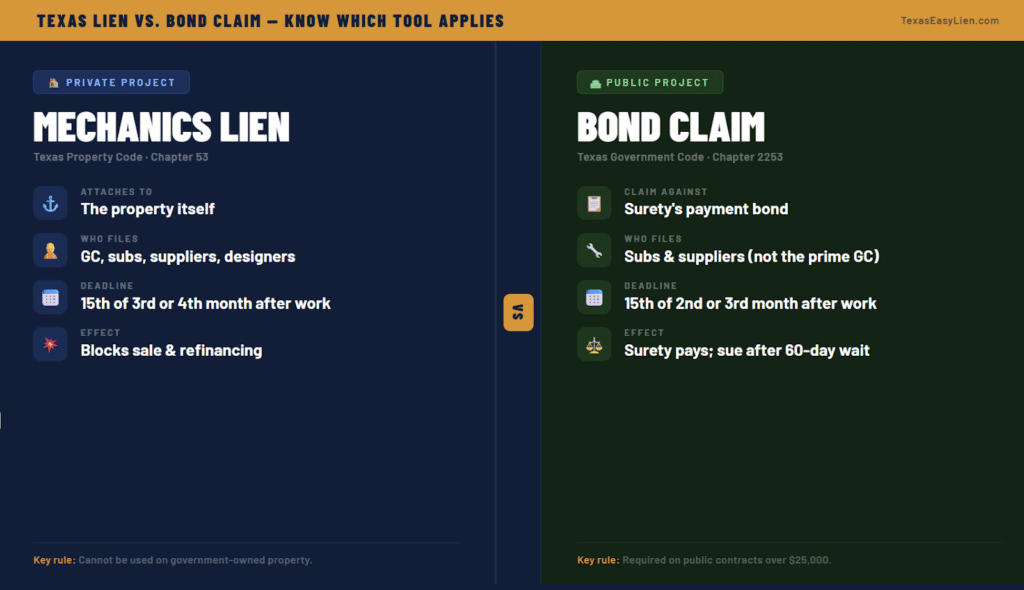
The core difference comes down to one thing: who owns the property. If the property is privately owned, a mechanics lien is your tool. If the property belongs to a government entity — a city, county, school district, or the State of Texas — a bond claim is your remedy. This isn’t a choice; it’s determined entirely by the nature of the project.
A mechanics lien (also called a mechanic’s, contractor’s, or materialman’s lien) is a legal claim that attaches directly to private real property. It gives unpaid contractors a security interest in the property itself, which can ultimately force a sale or block refinancing until the debt is resolved. It is one of the most powerful collection tools available under Texas law, governed by Chapter 53 of the Texas Property Code.
A bond claim, on the other hand, is a claim made against a payment bond — a financial guarantee provided by a surety (insurance) company. Because you cannot attach a lien to government-owned property in Texas, the law requires general contractors on most public projects to obtain a payment bond before work begins. If you’re not paid, you file a claim against that bond rather than against the property itself. Bond claims on public projects are governed by Chapter 2253 of the Texas Government Code, sometimes referred to as the Little Miller Act.
Both tools are powerful, both have strict deadlines, and both require specific paperwork filed in a specific sequence. The Texas lien vs. bond claim distinction is not one you want to figure out after the fact.
When Can You File a Mechanics Lien in Texas?
A mechanics lien is available when you’ve performed labor or furnished materials on a privately owned construction project and haven’t been paid. This covers commercial buildings, residential homes, apartment complexes, retail centers, and any other property held by a private individual or business entity. The lien attaches to the real property itself and creates a cloud on the title, meaning the owner cannot sell or refinance without resolving the debt.
General contractors, subcontractors, sub-subcontractors, and suppliers can all file mechanics liens in Texas, though the process and deadlines vary depending on your role in the project. General contractors have the most straightforward path — no pre-lien notice is required, and they must file a lien affidavit within four months of completion, termination, or abandonment of the contract on commercial projects, or within three months on residential projects.
Subcontractors and suppliers on commercial projects must first send a pre-lien notice (sometimes called a fund-trapping notice) by the 15th day of the third month following the month work was performed. That notice is what triggers the owner’s obligation to retain funds for your benefit. Missing it doesn’t necessarily kill your claim, but it significantly weakens your leverage. The lien affidavit must then be filed by the 15th day of the fourth month after each month of unpaid work.
One important update to know: under Texas Property Code §53.003(e), as amended by House Bill 2237 effective January 1, 2022, if any of these 15th-of-the-month deadlines fall on a weekend or legal holiday, the deadline automatically extends to the next business day. This was a meaningful change for contractors who previously had to scramble when deadlines landed on a Sunday or holiday.
What Is a Bond Claim in Texas, and When Do Contractors Use It?
When you’re working on a public works project — a school, road, government building, public park, sewer system, or similar government-owned infrastructure — liens are simply not an option. Texas law prohibits attaching a mechanics lien to publicly owned real property. Instead, the law provides subcontractors and suppliers with the right to make a bond claim in Texas as their primary collection tool on public work.
Here’s how it works: for any public construction contract exceeding $25,000, the prime contractor is required by law to obtain a payment bond from a surety company. That bond is a financial promise that all subcontractors and suppliers will be paid. If the prime contractor fails to pay, you file a claim directly against that bond — and the surety company becomes responsible for satisfying your debt.
A public project bond claim requires a sworn statement of account, a written notice of the claim, and strict adherence to certified mail requirements. First-tier subcontractors — those who have a direct contract with the prime contractor — must send notice to both the prime contractor and the surety by the 15th day of the third month following each month of unpaid work.
If you’re a second-tier sub or supplier (meaning you were hired by a subcontractor, not directly by the prime), you have an additional step. You must send a second-month notice to the prime contractor by the 15th day of the second month after work is performed, before sending the full bond claim to the prime and surety. Missing this early notice can result in losing your bond rights entirely.
One practical step that can save you later: before you start any public project, request a copy of the payment bond in writing. The prime contractor is required to provide it within 10 days of a written request. Having the bond number, surety name, and surety contact information on hand before problems arise makes the filing process far smoother.
Who Can File a Texas Lien vs. Bond Claim? An Eligibility Overview
One of the most common points of confusion is figuring out which tool you’re eligible to use based on your role in the project. Understanding this upfront is essential, so here’s the breakdown.
On a private project, the following parties can file a mechanics lien in Texas:
- General (prime) contractors with a direct contract with the property owner
- First-tier subcontractors hired by the general contractor
- Second-tier subcontractors (sub-subcontractors) hired by a first-tier sub
- Material suppliers who delivered materials used in the project
- Licensed architects, engineers, and surveyors who provided professional services
On a public project, the following parties can file a bond claim under Texas law:
- First-tier subcontractors with a direct contract with the prime contractor (single notice required)
- Second-tier subcontractors and suppliers hired by a first-tier sub (two separate notices required)
- Material suppliers to subcontractors on public projects
- Note: General (prime) contractors do NOT file bond claims — they are the party who procures the bond, not a claimant against it
There is one narrow exception worth knowing: on public contracts under $25,000 with governmental entities other than municipalities, Texas Property Code §53.231 provides a limited statutory lien on the money owed to the contractor (not on the property itself). In practice, the vast majority of public works projects exceed this threshold, so the bond claim route applies in almost every real-world situation.

What Are the Deadlines for a Texas Lien vs. Bond Claim?
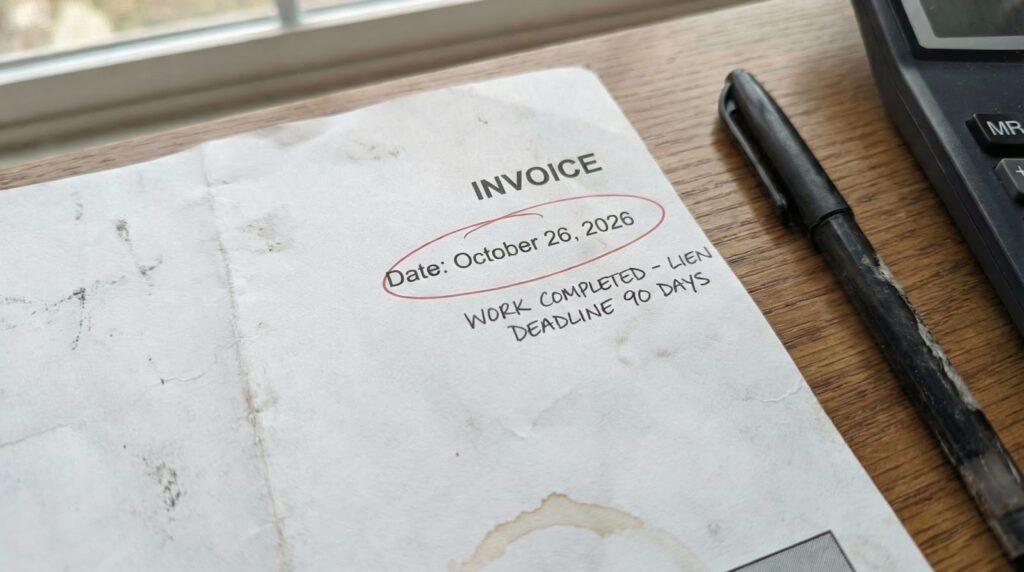
Deadlines are where contractors most often lose their rights. Both mechanics liens and public project bond claims in Texas operate on monthly rolling deadlines tied to the month in which work was performed — not when invoices were issued or when you first realized payment wasn’t coming. Each month of unpaid work creates its own separate deadline track.
Mechanics Lien Deadlines (Private Projects):
- General contractors (commercial): File lien affidavit by the 15th of the 4th month after project completion
- General contractors (residential): File lien affidavit by the 15th of the 3rd month after project completion
- Subcontractors (commercial): Send pre-lien notice by the 15th of the 3rd month; file lien affidavit by the 15th of the 4th month after work was performed
- Subcontractors (residential): Send pre-lien notice by the 15th of the 2nd month; file lien affidavit by the 15th of the 3rd month
Bond Claim Deadlines (Public Projects):
- First-tier subcontractors: Send notice with sworn statement of account to prime contractor AND surety by the 15th of the 3rd month after work was performed
- Second-tier subs/suppliers: Send a 2nd-month notice to prime contractor by the 15th of the 2nd month, then send the full bond claim to both prime contractor and surety by the 15th of the 3rd month
- After filing: You must wait 60 days before suing on the bond
- Lawsuit deadline: File suit within 1 year from the date the claim was perfected (or 2 years if the bond was not recorded at the time of filing)
All of these are hard cutoffs. Miss the pre-lien notice by one day and your claim may be significantly weakened or lost entirely. This is why it pays to understand the lien and bond claim deadline schedule for each month you work on a project, and to track deadlines separately for each month work was performed. As established under Texas Property Code §53.003(e), if the 15th falls on a weekend or legal holiday, the deadline shifts to the next business day.
What Happens If You File the Wrong Claim or Miss a Deadline?
Filing a mechanics lien against a government-owned property is not just ineffective — it’s invalid under Texas law. Government entities cannot have liens placed against their properties, and any attempt to do so would be dismissed outright. Similarly, attempting to use the wrong tool for your project type, or filing with missing or incorrect information, can result in your claim being entirely unenforceable.
Missing the deadline for a pre-lien notice on a commercial project doesn’t always void the lien entirely, but it eliminates your ability to trap funds — meaning the owner has no legal obligation to withhold payment from the general contractor on your behalf. That significantly reduces your leverage. If you also miss the lien affidavit deadline, you lose your lien rights for that month’s work permanently.
For bond claims, the consequences are equally serious. If a second-tier subcontractor misses the second-month notice requirement on a public project, they may lose their bond claim rights entirely for that period. The surety has no obligation to pay a claim that wasn’t properly perfected. And once the one-year lawsuit window closes after perfecting a claim, the right to recover is extinguished — regardless of how much money you’re owed.
This is also why it matters to identify the project type before you break ground. A project that looks private might involve a governmental lessee, a public-private partnership, or a similar structure that changes your legal options entirely. When there’s any doubt about ownership, research it before your first day on site. It’s also worth understanding what happens if an improper lien is filed, including the distinction between an invalid lien and a fraudulent one — the legal consequences for each are very different.

Frequently Asked Questions
Can a general contractor file a bond claim on a public project?
No. The general (prime) contractor is the party who obtains the payment bond — they cannot file a claim against their own bond. Bond claims are available to subcontractors, sub-subcontractors, and suppliers working under the prime contractor. If the prime contractor isn’t paid by the government entity, their remedy runs through the contract and other legal channels, not a bond claim.
What if I’m working on a public-private partnership — do I file a lien or a bond claim?
This depends on the specific ownership structure of the project. If the underlying property is held by a government entity, lien rights generally do not attach. If the property is privately held even within a public-private arrangement, mechanics lien rights may still be available. It’s critical to verify actual property ownership before starting work. When there’s any uncertainty, preparing for a bond claim is the safer move so you don’t lose your notice window.
Do I need an attorney to file a lien or bond claim in Texas?
No. Texas law allows contractors, subcontractors, and suppliers to prepare and file their own lien affidavits and bond claim documents without legal representation. Online platforms built for this purpose generate the proper forms, handle notarization, and guide you through the correct filing sequence — all for a fraction of what attorney fees would cost.
What is the difference between a lien release and a bond claim?
A lien release cancels an existing mechanics lien once payment is received — it closes the lien process. A bond claim is a completely separate remedy used on public projects where no mechanics lien was ever filed. They serve different purposes at different stages: one ends a private dispute, the other initiates a public project collection. Don’t confuse them.
Don’t Let the Wrong Tool Cost You Your Payment
Whether you’re working on a private commercial project or a state highway job, you’ve earned your pay. Knowing whether to pursue a Texas lien vs. bond claim isn’t a legal technicality reserved for attorneys — it’s practical knowledge every contractor needs before they pick up the first tool on a job. Get the right tool in place early, and you have real leverage to collect what you’re owed. Choose wrong, or wait too long, and your legal options may be gone entirely.
The key takeaways are simple: private property gets a mechanics lien, public property gets a bond claim under Texas law. Both require timely notices sent by certified mail. Both operate on strict monthly deadlines tied to when work was performed. And both are far easier to execute when you’ve gathered the right project information from day one — not after payment problems have already started.
If you’ve done work in Texas and haven’t been paid — on a school, a city project, a private commercial build, or a residential remodel — Texas Easy Lien makes the process fast, affordable, and straightforward. No attorney needed. For as little as $299, you can have your lien affidavit or bond claim prepared, notarized, and ready to file in about 15 minutes. Get started today and protect the money you’ve already earned.