
Texas lien law 2026 requirements are stricter than ever, but the 2025 Texas lien law changes offer welcome relief for contractors tracking tight deadlines.
- SB 929 now extends any deadline falling on a weekend or holiday to the next business day
- Four additional 2025 laws affecting trust funds, venue clauses, and public project payments took effect September 1, 2025
- HB 2237 from 2022 remains the foundation governing notices, forms, and filing procedures
- Missing a single deadline can still eliminate your right to payment entirely
Know the current rules, or risk losing the money you’ve earned.
Why Does Texas Lien Law 2026 Matter for Your Business?
Construction contractors continue facing significant payment challenges. According to the 2024 Rabbet Construction Payments Report, 82% of contractors now experience payment delays exceeding 30 days, up dramatically from 49% just a few years ago. The construction industry lost an estimated $280 billion to slow payments in 2024 alone.
Texas mechanic’s lien laws exist specifically to protect contractors, subcontractors, and suppliers from these payment problems. When properly executed, a lien creates a legal claim against the property itself, giving you leverage to collect what you’re owed without expensive litigation.
But here’s the challenge: Texas lien law 2026 requirements remain among the most complex in the nation. The Texas Property Code Chapter 53 establishes precise deadlines, mandatory notice requirements, and specific forms that must be followed exactly. One missed deadline or improperly formatted notice can invalidate your entire claim.
The good news? Recent legislative changes have made compliance somewhat easier. Understanding these updates is essential for any contractor working in Texas today.
What Are the Key 2025 Texas Lien Law Changes?
The 89th Texas Legislative Session, which ran from January through June 2025, produced several important 2025 Texas lien law changes affecting the construction industry. While lawmakers filed thousands of bills, only a handful directly impacted mechanic’s lien procedures.
Senate Bill 929: The Deadline Extension Rule
The most significant change came through Senate Bill 929, signed by Governor Abbott on May 21, 2025, with immediate effect. This law addresses a long-standing source of confusion and frustration for contractors.
Previously, if a statutory lien deadline fell on a Saturday, Sunday, or legal holiday, contractors faced uncertainty about whether they could file the following business day. Courts had issued conflicting interpretations, leaving many contractors anxious about deadlines landing on weekends.
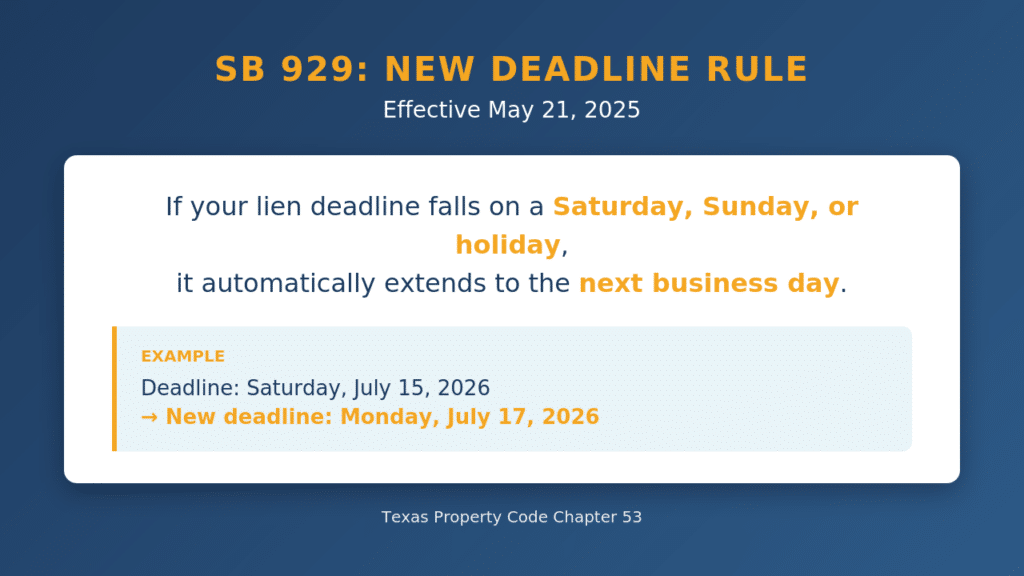
SB 929 eliminates this ambiguity completely. The law now explicitly states that when determining any deadline under Chapter 53, if that deadline falls on a Saturday, Sunday, or legal holiday, the period automatically extends to the next day that is not a weekend or holiday.
For example, if your lien affidavit filing deadline lands on Saturday, July 15, 2026, you now have until Monday, July 17, 2026, to file without losing your rights.
Additional September 2025 Changes
Several other construction-related bills took effect on September 1, 2025:
SB 841 (Construction Trust Fund Assignments): This law amends the Texas Construction Trust Fund Act to allow contractors, subcontractors, and suppliers to assign their trust fund rights to upstream parties in the payment chain. The assignment must be in writing, made only after payment, and cannot be part of the original contract.
HB 2960 (Texas Venue Requirements): Construction contracts can no longer require disputes to be litigated in another state. Any out-of-state venue clause is now void, not merely voidable. This protects Texas contractors from being forced into unfamiliar legal jurisdictions.
HB 3005 (Public Project Prompt Payment): For public works projects, an audit extending more than 60 days after substantial completion no longer qualifies as a “bona fide dispute” that allows withholding payment. This prevents public entities from indefinitely delaying contractor payments by citing prolonged audits.
How Does HB 2237 Still Affect Your Lien Rights in 2026?
While the 2025 Texas lien law changes are important, the foundation of current requirements comes from House Bill 2237, enacted in 2022. This sweeping legislation modernized many aspects of the mechanic’s lien process and continues to govern all contracts signed on or after January 1, 2022.
Understanding these provisions remains critical for contractors working today.

Expanded Notice Delivery Methods
Before HB 2237, all lien notices had to be sent via certified mail or delivered in person. The updated law allows contractors to use “any other form of traceable, private delivery or mailing service that can confirm proof of receipt.” This includes FedEx, UPS, and similar services.
However, certified mail remains the preferred method because it’s effective upon mailing, not receipt. Other delivery methods require actual proof of receipt to be valid.
Unified Subcontractor Deadlines
HB 2237 eliminated the distinction between first-tier and second-tier subcontractors for notice purposes. Previously, sub-subcontractors had shorter notice windows than direct subcontractors. Now all subcontractors follow the same timeline regardless of their position in the contract chain.
Standardized Notice Forms
The law introduced statutory forms for the Notice of Claim for Unpaid Labor or Materials and the Notice of Claim for Unpaid Retainage. Using these standardized forms helps ensure compliance and reduces the risk of rejection due to formatting errors.
Design Professional Protections
Licensed architects, engineers, and surveyors no longer need direct contractual relationships with property owners to file valid liens. This expanded protection helps design professionals secure payment for their work even when hired by contractors rather than owners.
One-Year Enforcement Deadline
HB 2237 standardized the deadline for filing suit to foreclose a lien at one year for all project types. Previously, commercial projects had a two-year window while residential projects had one year. This unified timeline requires faster action to enforce lien rights.
What Are the Current Lien Filing Deadlines in Texas?
Understanding current Texas lien law 2026 deadlines is essential for protecting your payment rights. These deadlines are based on the month work was performed, not when invoices were sent.
For Original Contractors (GCs)
Original contractors who contract directly with property owners have the most straightforward requirements:
- Commercial projects: File lien affidavit by the 15th day of the fourth month after work completion, termination, or abandonment
- Residential projects: File lien affidavit by the 15th day of the third month after work completion
- No preliminary notice required (except disclosure statements on residential projects)
For Subcontractors and Suppliers
Parties without direct owner contracts face additional notice requirements:
Commercial Projects:
- Send Notice of Claim for Unpaid Labor or Materials by the 15th day of the third month after work was performed
- File lien affidavit by the 15th day of the fourth month after work was performed
Residential Projects:
- Send Notice of Claim by the 15th day of the second month after work was performed
- File lien affidavit by the 15th day of the third month after work was performed
Retainage Claims
For contractual retainage, send the Notice of Claim for Unpaid Retainage within 30 days after your contract is completed, terminated, or abandoned.
5 Critical Texas Lien Law Requirements Every Contractor Must Follow
Success with Texas mechanic’s liens requires attention to multiple requirements beyond just meeting deadlines. Here are the essential elements:
- Accurate property identification: Your lien affidavit must include a legal description sufficient to identify the property. Using the correct legal description from county records is crucial. Errors here can invalidate your entire claim.
- Proper notice content: Statutory notices must include specific information including project description, claimant name and contact information, original contractor name, and claim amount. Incomplete notices may not preserve your rights.
- Correct recipient identification: Notices must go to both the property owner and the original contractor. For sub-subcontractors, notices to each party above you in the contract chain may be required.
- County clerk filing: Lien affidavits must be filed with the county clerk in the county where the property is located. The clerk will record the affidavit and index it under both the claimant’s and owner’s names.
- Post-filing notice: After filing your lien affidavit, you must send a copy to the owner and original contractor within five days. This requirement is separate from preliminary notices.
How Do Residential and Commercial Project Requirements Differ?
One of the most important distinctions in Texas lien law involves project classification. The definition of “residential” under Texas law is narrower than many contractors expect.
What Qualifies as Residential?
Under Texas Property Code, a residential construction project involves a single-family house, duplex, triplex, or quadruplex that is owned by an adult who uses or intends to use it as their dwelling. The key factor is owner occupancy.
Projects that seem residential but legally aren’t include:
- Spec homes built for sale (no owner-occupant at time of construction)
- Rental properties (owner doesn’t live there)
- Investor-owned multi-family buildings
- Commercial developments that include residential units
Homestead Requirements
Filing liens on Texas homesteads involves additional requirements. Original contractors must have a written contract signed by both spouses (if married) and filed with the county clerk before work begins. Subcontractors’ liens depend on the original contractor meeting these requirements.
Lien affidavits on homesteads must include specific statutory language: “NOTICE: THIS IS NOT A LIEN. THIS IS ONLY AN AFFIDAVIT CLAIMING A LIEN.”
How Can You Stay Compliant With Current Texas Lien Law?
Protecting your lien rights requires systematic processes, not last-minute scrambling. Implementing these practices helps ensure you never miss a critical deadline.
Track Every Project from Day One
Begin tracking lien deadlines when work starts, not when payment problems arise. Document the month work was performed for each portion of a project, as this determines your notice and filing deadlines. Keep copies of all contracts, invoices, and correspondence organized by project.
Build in Safety Margins
Even with the SB 929 weekend/holiday extension from the 2025 Texas lien law changes, aim to file several days before actual deadlines. Unexpected issues with notarization, county filing systems, or delivery services can arise. These deadline extensions help, but filing early eliminates stress entirely.
Use Standardized Forms
The statutory notice forms introduced by HB 2237 provide a template for compliance. While slight variations may be acceptable, using the standardized format reduces rejection risk and speeds the filing process.
Verify Property Information
Before filing, confirm the property’s legal description and current owner information through county records. Errors in property identification are among the most common reasons liens fail. Many counties offer online property search tools that provide current ownership and legal description data.
Consider Professional Assistance
For high-value claims or complex situations, professional lien filing services can provide valuable guidance. These services understand current Texas lien requirements and can help ensure your documentation meets all statutory requirements.
Frequently Asked Questions About Texas Lien Law 2026
Did Texas pass any new lien laws for 2026?
No new lien legislation has been enacted specifically for 2026. The Texas Legislature meets biennially, so the 90th session won’t convene until 2027. Current law is governed by the 2025 Texas lien law changes (primarily SB 929) and the foundational HB 2237 from 2022.
What happens if my lien deadline falls on July 4th, 2026?
Under SB 929, your deadline automatically extends to the next business day. If July 4th falls on a Saturday, you would have until Monday, July 6th to file. This applies to all deadlines under Chapter 53 of the Texas Property Code.
Do I need to send preliminary notice as a general contractor?
Generally, no. Original contractors with direct owner contracts are not required to send preliminary notices on commercial projects. However, residential projects require disclosure statements and subcontractor lists unless the owner waives this requirement in writing.
Can I still file a lien if I missed the preliminary notice deadline?
Missing the preliminary notice deadline typically eliminates your ability to file a valid lien, with limited exceptions. However, you may still have contractual claims or other legal remedies. Consult with a construction attorney to evaluate your specific situation.
Protect Your Right to Payment in 2026
Texas lien law 2026 balances strict compliance requirements with recent reforms that make the process more manageable. The 2025 Texas lien law changes, particularly SB 929, provide breathing room when deadlines fall on weekends or holidays. The HB 2237 foundation offers expanded delivery options and unified timelines. Additional 2025 legislation protects contractors on venue issues, trust fund assignments, and public project payments.
But these protections only work if you follow the rules precisely. Miss a deadline, skip a required notice, or file with incorrect information, and you may lose your right to payment entirely.
The contractors who get paid consistently are those who understand these requirements and implement systematic processes to meet them. Whether you’re a general contractor, subcontractor, or supplier, knowing current Texas lien law is how you protect the money you’ve earned.
Ready to file your lien documents with confidence? Texas Easy Lien provides an affordable, attorney-designed platform that guides you through every step of the process. Prepare, notarize, file, and mail your construction lien documents online in minutes. Get started today and protect your right to payment.