What Every Property Developer Needs to Know to Avoid Costly Lien Claims
Lien law creates significant but often overlooked financial risk for Texas real estate developers.
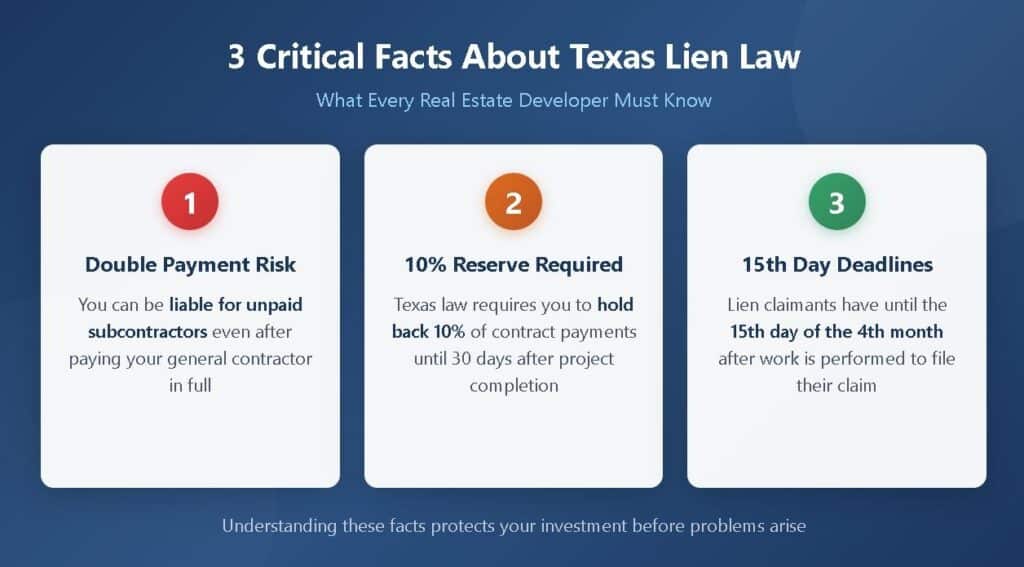
- Developers can be held liable for unpaid subcontractors even after paying the general contractor in full.
- Texas law requires developers to reserve 10% of contract payments as a protected fund.
- The 2022 law changes expanded who can file liens, including architects, engineers, and surveyors working as subcontractors.
- Understanding notice requirements and deadlines is the most effective way to prevent liens from clouding your title.
Proactive payment tracking and proper documentation protect your property far better than reactive legal battles.
If you’re developing property in Texas, you’re working in one of the most active construction markets in the country. But with that opportunity comes a legal reality that catches many developers off guard: mechanic’s lien laws can directly threaten your property even when you’ve done everything right with your general contractor.
Slow payments cost the construction industry $280 billion in 2024, creating a ripple effect that eventually lands on property owners’ doorsteps. When contractors don’t pay their subcontractors, those unpaid parties have the legal right to file a lien against your property. Suddenly, that commercial building you’ve invested millions in has a cloud on the title that blocks sales, refinancing, and lease negotiations.
Lien law for developers in Texas is about protecting your investment before problems arise. Texas Property Code Chapter 53 governs these liens, and the rules apply whether you’re building a strip mall in Houston, a mixed-use development in Austin, or an industrial facility in Dallas-Fort Worth.
What Should You Know About Lien Law for Developers in Texas?
The core challenge for developers is straightforward but frustrating: you can pay your general contractor every penny owed and still face liens from subcontractors you’ve never met. Texas law gives lien rights to anyone who provides labor or materials for construction, regardless of whether they have a direct contract with you.
The lien process in Texas allows subcontractors, material suppliers, equipment rental companies, and design professionals to place claims against your property. Since 2022, this list has expanded further. Architects, engineers, and surveyors now have lien rights even when working as subcontractors rather than contracting directly with the owner.
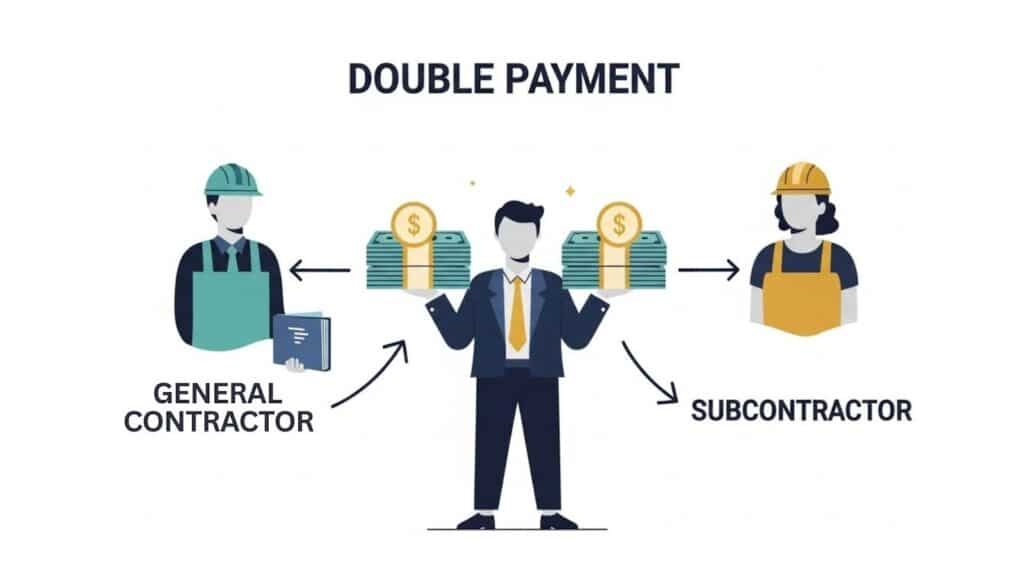
The Double Payment Problem
Suppose you’ve paid your general contractor $500,000 for completed work. Two months later, you receive notice that a roofing subcontractor wasn’t paid $75,000 for their portion of the project. Under Texas lien law, that subcontractor can file a real estate lien in Texas against your property.
If you want to sell or refinance, you’ll likely need to resolve that claim. That might mean paying the $75,000 yourself and then pursuing the general contractor for reimbursement. You’ve now paid twice for the same work, and you’re stuck trying to collect from a contractor who may be financially unstable or simply uncooperative.
This scenario happens regularly on Texas construction projects, particularly when general contractors run into cash flow problems or go out of business mid-project.
Reserved Funds Requirements
Texas law attempts to address this risk through the reserved funds requirement. As a property owner or developer, you’re required to hold back 10% of contract payments throughout the project and for 30 days after completion. This reserved fund protects subcontractors and suppliers who properly file notices and liens.
Here’s the catch: if you fail to maintain this reserve and a valid lien is filed, your personal liability isn’t limited to what you should have reserved. You become liable for the full amount of the lien claim, potentially far exceeding that 10% figure.
The reserved funds also create a deadline trigger. Claimants who want to access this fund must file their lien affidavit within 30 days after project completion, creating a tighter timeline than the standard lien filing deadlines.
What Are Key Deadlines in the Lien Process in Texas?
Deadlines are everything in Texas lien law. For developers, understanding these timelines helps you anticipate when claims might appear and when your exposure ends.
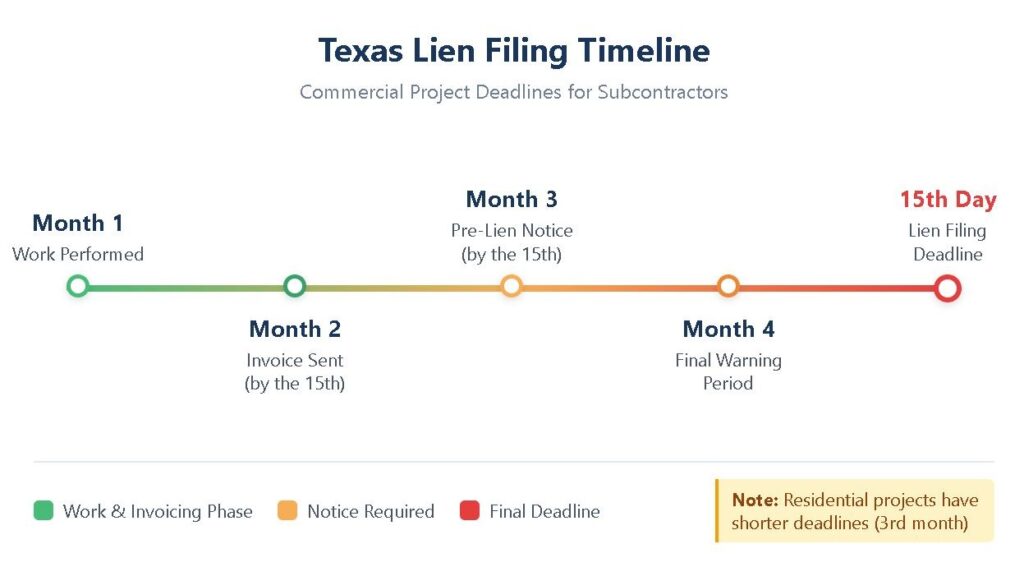
Original contractors working directly with you must file their lien affidavit by the 15th day of the fourth month after their work is completed, terminated, or abandoned on commercial projects. Residential projects have a shorter window of three months.
Subcontractors face similar deadlines but must first send a pre-lien notice. For commercial projects, this notice must reach you and the general contractor by the 15th day of the third month after the work was performed. The lien affidavit filing deadline follows in the fourth month.
One important update from the 2022 law changes: if a deadline falls on a weekend or legal holiday, it automatically extends to the next business day. This seems like a small detail, but it’s rescued countless lien claims from technical invalidation.
For developers, the Texas Real Estate Research Center notes that these deadlines are strictly enforced. Courts won’t accept late filings, and missing even one procedural step can invalidate an otherwise legitimate claim. This works both ways. A poorly executed lien claim against your property may be vulnerable to challenge.
5 Ways Developers Can Protect Against Real Estate Liens in Texas
Understanding property developers’ lien risk is the first step. Here’s how to minimize it:
1. Require Payment Affidavits Before Each Disbursement. Before releasing any payment to your general contractor, request a sworn affidavit stating that all subcontractors and suppliers have been paid for previous work. Texas law allows you to require this documentation, and it creates a paper trail if disputes arise later.
2. Track Pre-Lien Notices and Respond Appropriately. When you receive a notice of claim for unpaid labor or materials, don’t ignore it. This notice triggers your right to withhold funds from future payments to the general contractor. Take advantage of this protection by immediately holding back enough to cover the claimed amount.
3. Collect Lien Waivers at Every Payment Stage. Conditional and unconditional lien waivers document that subcontractors have been paid and release their right to file future claims for that work. Building this requirement into your payment process provides documentation and reduces your exposure over time.
4. Maintain the 10% Reserved Fund Religiously. Even when your general contractor presses for full payment, resist releasing the reserve until you’re certain all downstream parties have been paid. The 30-day post-completion waiting period exists for good reason.
5. Verify Subcontractor and Supplier Information Upfront. Ask your general contractor for a complete list of parties working on the project. Knowing who’s on site helps you identify potential claimants and track incoming notices more effectively.

What Are Common Mistakes Developers Make with Texas Liens?
Even experienced professionals stumble when it comes to understanding lien law for developers in Texas. Here are the mistakes that create the biggest problems:
Paying the general contractor too quickly after project completion. The 30-day post-completion window exists because subcontractors have time to file claims. Releasing all funds immediately leaves you vulnerable if notices arrive late.
Failing to document payments through the contractor chain. Without payment affidavits and lien waivers, you have no evidence that funds actually reached subcontractors. In a dispute, this lack of documentation weakens your position.
Ignoring pre-lien notices. These notices aren’t threats to panic about, but they’re also not junk mail to discard. Each notice represents a potential claim and triggers your legal right to protect yourself by withholding funds. Missing this window can prove costly.
Assuming residential rules apply to spec homes. A common misconception is that any home construction counts as residential under Texas lien law. That’s not accurate. Spec homes, investment properties, and rental units follow commercial project rules, with longer deadlines and different procedures. Only properties where the owner will actually reside qualify as residential construction projects under the Property Code definition.
Frequently Asked Questions
Can a subcontractor file a lien even if I paid the general contractor? Yes. Texas lien law allows subcontractors, suppliers, and other parties to file liens against your property if they weren’t paid, regardless of whether you fulfilled your obligations to the general contractor.
How long do I have before a lien expires on my property? Lien claimants must file suit to foreclose within one year from the last possible day they could have filed the lien affidavit. The property owner and claimant can agree in writing to extend this to two years, but without enforcement action, the lien eventually becomes unenforceable.
Do I need a lawyer to handle every lien notice I receive? Not necessarily. Many lien notices are routine and resolve through normal payment processes. However, if a lien is actually filed against your property or you’re facing a foreclosure action, legal consultation is advisable. For straightforward documentation and filing needs, online services provide cost-effective alternatives.
What’s the difference between a pre-lien notice and an actual lien? A pre-lien notice is a warning that a subcontractor or supplier hasn’t been paid and preserves their right to file a lien. It does not encumber your property. A lien affidavit is the actual filing that creates a legal claim against your property and gets recorded with the county clerk.
Protecting Your Development Investment
Managing lien risk isn’t about being paranoid or adversarial with contractors. Most construction projects in Texas are completed without any lien disputes. The goal is to have systems in place before problems develop rather than scrambling after a notice arrives.
Good documentation, consistent payment procedures, and basic knowledge of lien deadlines give developers the tools to identify problems early. When you understand how mechanic’s liens work from both sides, you’re better positioned to negotiate with contractors, protect your property, and keep projects moving forward.
For developers who want to understand their exposure or need to respond to a lien notice, Texas Easy Lien provides accessible tools to navigate these requirements without expensive attorney fees.