
Key Takeaways
If your subcontract includes a retainage clause, you must send a special notice to protect your right to collect that withheld money.
- Contractual retainage is separate from the 10% statutory retainage Texas law requires property owners to hold back
- You must send a notice of contractual retainage within 30 days of completing your work or 30 days after the original contract ends, whichever comes first
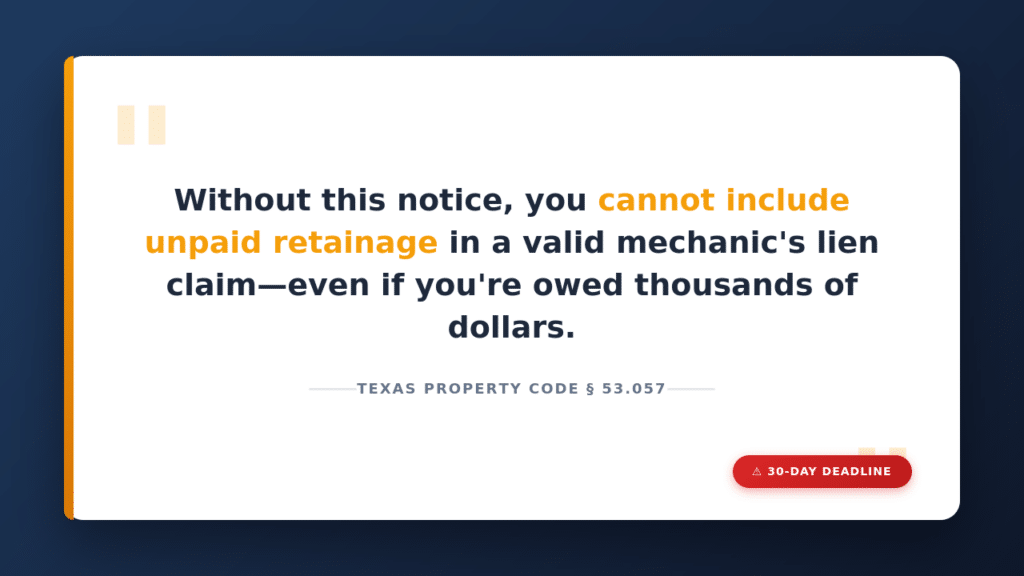
- Without this notice, you cannot include unpaid retainage in a valid mechanic’s lien claim
- The notice must go to both the property owner and the original contractor
Missing this notice deadline means walking away from money you already earned.
If you work as a subcontractor in Texas, chances are you’ve had retainage withheld from your progress payments. That chunk of money sitting in someone else’s account while you wait for project completion can make or break your cash flow. According to Rabbet’s 2024 Construction Payments Report, 82% of contractors now face payment waits exceeding 30 days, and slow payments cost U.S. construction businesses an estimated $280 billion in extra expenses in 2024 alone.
When general contractors withhold retainage under a subcontract agreement, Texas law requires you to take an extra step to protect your payment rights. That step is sending a notice of contractual retainage. Without it, you could lose your ability to file a mechanic’s lien for that portion of your earnings. This guide breaks down exactly what this notice is, when you need to send it, and how to make sure you don’t forfeit the money you’ve worked hard to earn.
What Is a Notice of Contractual Retainage in Texas?
A notice of contractual retainage is a formal document that preserves your right to file a mechanic’s lien for retainage amounts withheld under your subcontract. Texas Property Code Section 53.057 specifically governs this requirement.
Here’s why this notice exists: Texas law recognizes two types of retainage, and they work differently. The first type is what the statute now calls “Reserved Funds,” which is the 10% that property owners must hold back from payments to the general contractor by law. The second type is simply called “Retainage,” which refers to amounts withheld according to the terms of a subcontract between a general contractor and subcontractor.
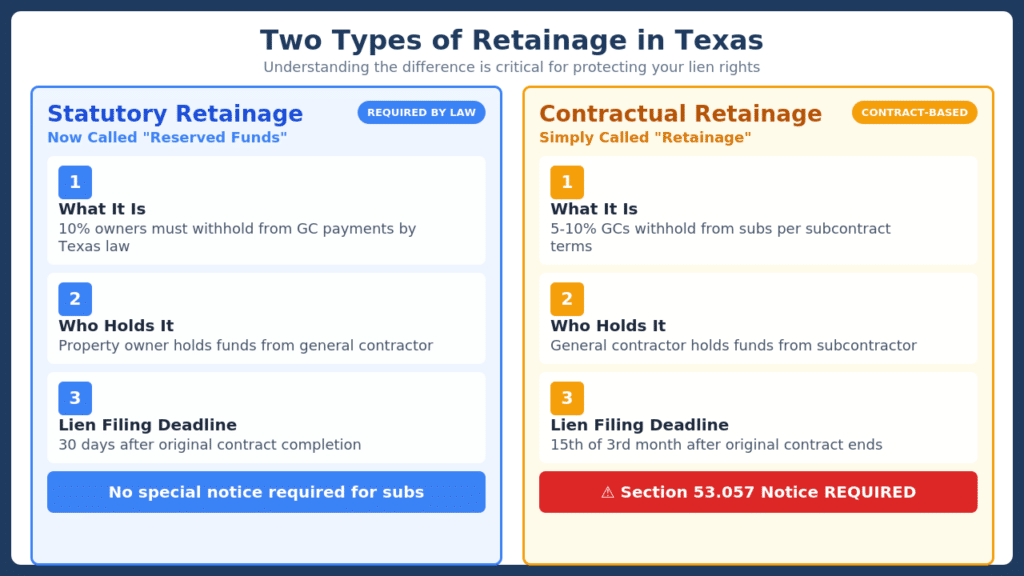
When a general contractor withholds retainage from your progress payments based on your subcontract terms, that money falls under the contractual retainage rules. To have a valid lien claim on those funds, you need to provide proper notice under Section 53.057. The regular pre-lien notice you send for unpaid labor and materials won’t automatically cover your retainage claim unless you specifically include it.
Think of the notice of contractual retainage as a separate notification that tells the property owner, “Hey, I have money being held back under my subcontract, and I want to make sure I can claim a lien on it if I don’t get paid.” Without this notice, you can’t attach your lien rights to those specific funds.
Why Does Contractual Retainage Exist?
General contractors include retainage clauses in subcontracts for the same reason owners use statutory retainage: it provides leverage to ensure work gets completed properly. When a GC holds back 5-10% of each payment until the project wraps up, subcontractors have a financial incentive to finish the job and address any punch list items.
The problem is that retainage amounts can represent a significant portion of your expected earnings on a project. If you’re working on a $100,000 subcontract with 10% retainage, that’s $10,000 sitting in someone else’s hands. For many subcontractors, especially smaller operations, that withheld amount can equal most or all of the profit they expected to make.
Making matters worse, there’s often a significant delay in contractor payment for retainage even after you finish your portion of the work. Many subcontracts tie retainage release to overall project completion, meaning you could finish in March and wait until December (or longer) to see that money. If the general contractor runs into financial trouble or the project stalls, that retainage may never arrive without legal protection.
This is precisely why Texas lien law retainage protections exist. The notice of contractual retainage gives subcontractors a way to secure their claim to those withheld funds, even when project circumstances change unexpectedly.
When Do You Need to Send This Notice?
Timing is everything with the notice of contractual retainage. Texas law sets a firm deadline, and missing it means losing your lien rights to those retainage funds permanently.
You must send the notice by the earlier of these two dates:
The first option is within 30 days after your contract is completed, terminated, or abandoned. This means 30 days from when you finish your scope of work under the subcontract, regardless of what’s happening with the rest of the project.
The second option is within 30 days after the original contract between the owner and general contractor is terminated or abandoned. If the main project falls apart before you complete your work, your notice deadline could arrive sooner than expected.
Whichever date comes first is your deadline. This creates a tricky situation because you might not know when the original contract is terminated or abandoned. The general contractor isn’t required to tell you, and by the time you find out, your deadline may have passed. That’s why many experienced subcontractors send this notice early, as soon as they complete their work, rather than waiting to see if payment issues develop.

Understanding Texas lien law deadlines is essential for protecting your business. The 30-day window for retainage notices is much shorter than the deadlines for regular pre-lien notices, which typically fall on the 15th day of the second or third month after you performed work. If you’re tracking multiple deadline types, this one can easily slip through the cracks.
One helpful change from House Bill 2237: if your deadline falls on a Saturday, Sunday, or legal holiday, it automatically extends to the next business day. But don’t use this as an excuse to wait until the last minute. The safest approach is treating every deadline as if no extensions apply.
What Information Must the Notice Include?
Texas Property Code Section 53.057 requires the notice of contractual retainage to follow a specific format. Here’s what you need to include:
- Property description: The address and enough information to identify the project location, typically including the county
- Your information: Your name or company name, mailing address, and contact person
- The party you contracted with: If you contracted with a subcontractor rather than the original contractor, include their name and address
- Total retainage unpaid: The dollar amount of retainage currently being withheld from you
- Warning language: The statutory form includes language warning the owner that the property may be subject to a lien if sufficient funds aren’t withheld
The notice can include an invoice or billing statement to support your claim. You should send it to both the property owner (or reputed owner) and the original contractor. If your contract is with a subcontractor rather than the GC directly, you must include the original contractor in your notice distribution.
Delivery methods expanded under the 2022 law changes. You can send the notice by certified mail, or through any traceable private delivery service (like FedEx or UPS) that can confirm proof of receipt. The key requirement is having documentation that the notice was received. Regular mail won’t provide the protection you need if a dispute arises later.
How a Notice of Contractual Retainage Protects Your Lien Rights
Sending the notice of contractual retainage does more than check a box. It actively protects your interests in several important ways.
First, the notice creates personal liability for the property owner regarding your retainage claim. Under Section 53.057(f) of the Texas Property Code, if you properly send notice and the owner doesn’t withhold sufficient funds, the owner becomes personally liable to you for those retained amounts. This gives you legal recourse beyond just the property itself.
Second, the notice triggers additional obligations from the owner. Once you’ve sent proper notice, the owner must inform you of certain events, including if the general contractor is terminated, if the project is abandoned, or if an affidavit of completion is filed. These notifications matter because they can affect your deadlines for filing a lien affidavit. According to guidance from the Texas Real Estate Research Center, subcontractors claiming a lien for retainage must file an affidavit no later than the 15th day of the third month after the original contract was completed, terminated, or abandoned.
Third, the notice preserves your ability to include unpaid retainage in a mechanic’s lien claim. If you need to file a lien in Texas for unpaid retainage, you cannot do so validly without having sent this notice first. The notice and the lien affidavit work together to create an enforceable claim.

This protection becomes especially important when projects go sideways. If a general contractor files for bankruptcy, abandons the job, or simply refuses to pay, having sent your notice of contractual retainage means you still have options. Without it, you’re an unsecured creditor with limited ability to recover what you’re owed.
Common Mistakes to Avoid with Retainage Notices
The retainage notice requirements trip up even experienced contractors. Here are the errors that most often cost subcontractors their lien rights:
Confusing the retainage notice deadline with other lien deadlines is the most frequent mistake. Your regular pre-lien notice for unpaid labor and materials has different timing requirements than the notice of contractual retainage. Many subcontractors assume their standard notice covers everything, but retainage in Texas requires its own separate notice unless you specifically included it in your earlier notice under Section 53.056.
Waiting to see if payment problems develop before sending the notice is another common error. By the time you realize the GC won’t pay your retainage, your 30-day window may have closed. The smart approach is sending the notice proactively once you complete your work, even if you expect payment to come through normally.
Failing to send the notice to all required parties can also invalidate your claim. If your subcontract is with the GC, you must send notice to both the GC and the property owner. If you’re a second-tier sub working under another subcontractor, you need to notify the original contractor as well as the owner.
Using non-traceable delivery methods leaves you without proof of receipt. If a dispute arises, you’ll need to demonstrate that your notice was actually received. Certified mail with return receipt requested remains the gold standard, but FedEx and UPS with tracking work too. Text messages, emails without delivery confirmation, and regular mail don’t provide adequate protection.
Frequently Asked Questions
Is the notice of contractual retainage the same as a pre-lien notice?
No, they’re different documents with different purposes. A pre-lien notice (formally called a Notice of Claim for Unpaid Labor or Materials) covers your general claim for unpaid work. The notice of contractual retainage specifically addresses retainage amounts withheld under your subcontract. You may need both notices to fully protect your lien rights, or you can include retainage claims in your regular pre-lien notice if you do so explicitly.
What happens if I miss the 30-day deadline for sending the retainage notice?
If you miss the deadline, you lose your ability to file a valid mechanic’s lien for the unpaid retainage. You might still have other legal options like filing a breach of contract claim, but you won’t have the security of a lien on the property. This is why tracking deadlines carefully is so important.
Do original contractors need to send a notice of contractual retainage?
No, Section 53.057 applies specifically to derivative claimants, meaning subcontractors and suppliers who don’t have a direct contract with the property owner. Original contractors have different notice requirements and don’t need this particular notice.
Can I send the retainage notice before I finish my work?
Yes, Texas law allows you to send the notice if you “are to labor” or “are to furnish labor or materials” under an agreement with retainage, not just after you’ve completed work. Sending early can be a smart strategy to ensure you don’t miss the deadline.
Getting Paid Shouldn’t Be This Complicated
Dealing with retainage delays and complicated notice requirements isn’t what you signed up for when you started your construction business. You want to do quality work and get paid fairly, without needing a law degree to navigate the process. Understanding the notice of contractual retainage is one more piece of protecting yourself in an industry where contractor payment delays remain all too common.
The good news is that you don’t have to figure out all the paperwork on your own. Texas Easy Lien helps contractors and suppliers prepare, notarize, file, and deliver their own official lien documents entirely online. When you need to protect your retainage claim or file a mechanic’s lien, get started today and take control of your payment rights.