If you supplied materials or labor for a Texas construction project and haven’t been paid, a Texas materialman’s lien may be your most powerful tool to collect.
- A materialman’s lien is a legal claim against property that suppliers, subcontractors, and contractors can use when they haven’t received payment for their work or materials.
- Texas law protects your right to file under both the state Constitution and Chapter 53 of the Texas Property Code, but only if you meet strict notice and deadline requirements.
- Deadlines vary based on your role (GC vs. sub), project type (commercial vs. residential), and the month work was performed, not when you invoiced.
- Missing even one deadline by a single day can permanently eliminate your right to file.
Know your rights before you lose them. The clock starts ticking the month you deliver materials or perform work.
Getting paid in construction shouldn’t require a legal battle, but for suppliers and subcontractors, it often does. According to Rabbet’s 2024 Construction Payments Report, slow payments cost the U.S. construction industry $280 billion in 2024 alone, with 82% of contractors reporting payment delays of more than 30 days. Material suppliers are among the hardest hit. When a general contractor stops paying or a project stalls, suppliers who delivered lumber, concrete, fixtures, or specialty materials can be left holding unpaid invoices with no clear path forward.
That’s exactly what the Texas materialman’s lien is designed to fix. This legal tool, rooted in the Texas Constitution and codified in state law, gives anyone who furnishes labor or materials for a construction project the right to place a claim directly against the property. Understanding how it works, who qualifies, and when to act can mean the difference between collecting what you’re owed and walking away empty-handed.
What Is a Texas Materialman’s Lien?
A Texas materialman’s lien is a legal claim placed against real property by a contractor, subcontractor, supplier, or laborer who provided materials or labor for a construction project and was not paid. It’s a type of mechanic’s lien, and in Texas, the two terms are often used interchangeably. The official name in the statutes is the “Mechanic’s, Contractor’s, or Materialman’s Lien,” but most people in the industry simply refer to it by whichever term reflects their primary claim.
A lien is a charge against property to secure payment of a debt. It is not title to property, and a lienholder does not have ownership rights. Rather, it is an equitable interest that gives its holder the right to have a debt satisfied out of the property. In practical terms, that means the property owner typically cannot sell, refinance, or obtain clear title insurance until your claim is resolved. That’s a powerful position to be in when you’re owed money.
This lien right is grounded in Article XVI, Section 37 of the Texas Constitution, which guarantees payment protection for mechanics, artisans, and materialmen. The Texas Legislature built on that constitutional foundation through Texas Property Code Chapter 53, which sets out the specific rules, deadlines, and procedures governing how these liens are filed and enforced. As the Texas Real Estate Research Center at Texas A&M has documented, the state has been continuously refining these protections to better serve tradespeople while balancing the rights of property owners.
The law was significantly updated by House Bill 2237, effective January 1, 2022. This update streamlined several notice procedures and changed key terminology. Most notably, what was commonly called a “pre-lien notice” is now officially referred to as a Notice of Claim. Any contract signed on or after January 1, 2022 is governed by these updated rules, so using old forms or outdated guidance can create serious problems fast.
Who Can File a Texas Materialman’s Lien?
One of the most common misconceptions is that only general contractors can file liens. That’s not accurate. The Texas Property Code makes lien rights available to any party who “labors, specially fabricates material, or furnishes labor or materials for construction or repair” of a property. This includes general contractors, subcontractors, material suppliers, engineers, architects, and a wide range of other construction professionals.
Here are the main categories of parties who may have lien rights:
- Material suppliers — Anyone who delivers concrete, lumber, steel, fixtures, roofing materials, or other supplies to a job site
- Subcontractors — Electricians, plumbers, framers, HVAC installers, and other trade contractors
- Sub-subcontractors — Those hired by subcontractors rather than directly by the GC
- Specially fabricated materials suppliers — Businesses that custom-manufacture items for a specific project, even if those materials were never delivered or installed
- Design professionals — Architects, engineers, and surveyors who provided designs or specifications under a written agreement
- Laborers — Workers who provided labor on the project, whether directly employed or through a subcontractor
Your role in the project and whether you have a direct contract with the property owner will determine which specific rules apply, but the right to file is broad. If you provided value to a Texas construction project and haven’t been paid, there is a good chance you have lien rights worth protecting.
Constitutional vs. Statutory: Two Types of Texas Materialman’s Liens
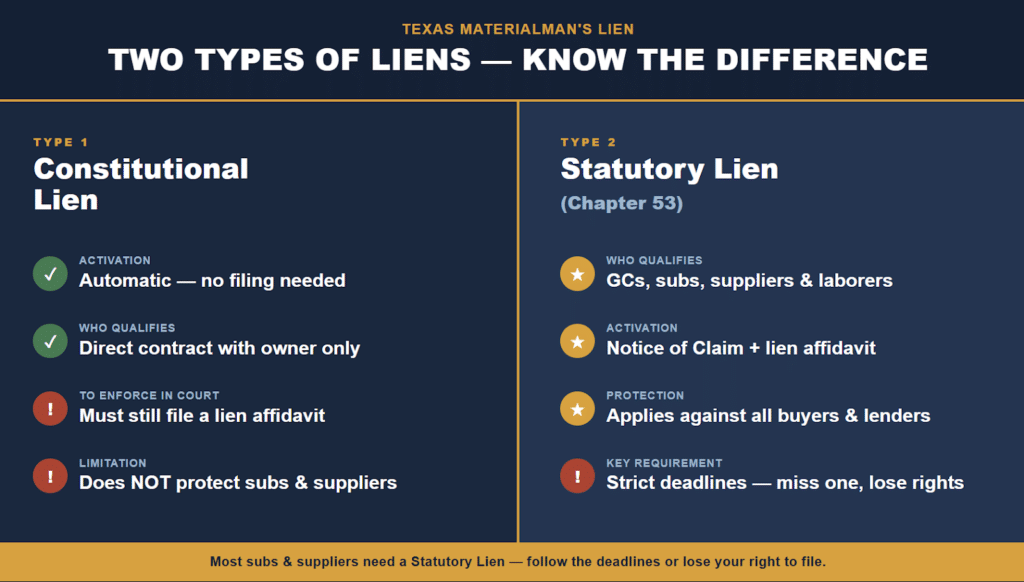
Texas law recognizes two distinct types of materialman’s liens, and understanding the difference matters for knowing how your rights work in practice.
A constitutional lien is self-executing. It attaches automatically when work begins and requires no preliminary filing or notice. The limitation is that it only applies to contractors and suppliers who have a direct contractual relationship with the property owner. If you were hired directly by the owner, this lien exists from the moment you start delivering materials or performing work, but you still need to file a lien affidavit if you want to enforce your rights in court. Without a recorded affidavit, a subsequent purchaser may take the property free of your claim.
In addition to the constitutional lien, contractors, subcontractors, and suppliers have access to a statutory mechanic’s lien under Chapter 53, which provides broader protection and applies against subsequent purchasers. Statutory liens require strict compliance with notice deadlines, specific document language, and affidavit filing procedures. These are the liens most subcontractors and material suppliers need, and the ones where following every step precisely determines whether your claim is valid or void.
Simply put: if you have a direct contract with the owner, you have automatic protection as a starting point. If you’re a supplier or sub without that direct relationship, the statutory process is what protects you, and it works well when you follow the rules.
What Are the Deadlines for a Texas Materialman’s Lien?
This is where most contractors and suppliers get into trouble. Deadlines are based on the month work was performed or materials were delivered, not when you invoiced and not when you expected payment. And if a project spans multiple months, each month of work has its own separate deadline clock. Combining everything into a single invoice at project’s end doesn’t create one deadline. It creates several, starting from the first month work occurred.
Deadlines for Original (General) Contractors
Original contractors are not required to send a Notice of Claim before filing their lien. On commercial projects, their lien affidavit must be filed within 4 months after the contract is completed, terminated, or abandoned. On residential projects, that window is 3 months from completion, termination, or abandonment.
Deadlines for Subcontractors and Suppliers on Commercial Projects
This is the most common scenario for material suppliers, and it involves a sequential notice-and-filing process:
- Send a Notice of Unpaid Balance to the property owner and GC by the 15th of the 2nd month following each month work was performed or materials were delivered
- Send a Notice of Claim to the property owner and GC by the 15th of the 3rd month following the work month
- File the lien affidavit with the county clerk by the 15th of the 4th month following the work month
Example: You deliver roofing materials in March. Your Notice of Unpaid Balance is due by May 15. Your Notice of Claim is due by June 15. Your lien affidavit must be filed by July 15.
Deadlines for Subcontractors and Suppliers on Residential Projects
Residential projects have shorter notice windows:
- Send a Notice of Claim by the 15th of the 2nd month after the work month
- File the lien affidavit by the 15th of the 3rd month after the work month
Example: You supply windows for a home addition in August. Your Notice of Claim is due by October 15. Your lien affidavit must be filed by November 15.
Important 2025 update: Under Senate Bill 929, effective 2025, if the 15th falls on a weekend or holiday, the deadline automatically extends to the next business day. This is a welcome change, but it is no reason to wait until the last minute.
How to File a Texas Materialman’s Lien: Step by Step
Filing a Texas materialman’s lien involves several sequential steps, each with legal requirements that must be met correctly. Here’s a plain-English walkthrough of the process.
Step 1: Document Everything From Day One
Before you can file, you need solid records: your contract or purchase order, delivery receipts, dated invoices, and written payment communications. Because deadlines run from when materials were delivered or labor performed, your records must be organized by calendar month, not by project or invoice date.
Step 2: Send Your Required Notices on Time
If you’re a subcontractor or supplier without a direct contract with the property owner, you must send the required notices before filing. The notices go to both the property owner and the original contractor and must use specific statutory language required by the Texas Property Code. That language instructs the owner to withhold funds from the GC to cover your unpaid claim. An incorrectly worded notice or one sent even a day late can waive your right to file a lien entirely. There are no exceptions for good-faith mistakes.
Step 3: Prepare the Lien Affidavit
The lien affidavit is the formal document filed with the county clerk that officially records your claim. It must include your full legal name and address, the property owner’s name and address, the original contractor’s name and address, a description of the work or materials, the amount claimed, a legally sufficient property description, and the dates work was performed. Every detail must be accurate. Errors in the property description or claimant information can render the lien invalid.
Step 4: Get the Affidavit Notarized
The lien affidavit must be notarized before filing. Online notarization platforms have made this step much easier, allowing you to complete it remotely in minutes without scheduling an in-person appointment.
Step 5: File With the County Clerk
File the notarized lien affidavit with the county clerk in the county where the property is located. Keep proof of filing including the date and recording number.
Step 6: Deliver Copies to the Owner and GC
After filing, send a copy of the recorded lien to the property owner and the general contractor. This puts both parties on formal notice that your claim is on record and that resolving it is required before any title transfer, refinancing, or construction loan draw can proceed.

What Happens After You File?
Filing the lien typically creates immediate pressure on the property owner to resolve your claim. In many cases, that pressure is enough to get you paid without ever going to court. Here’s what to expect once the lien is on record:
- A cloud is placed on the title. The lien becomes part of the public record in the county clerk’s office, and any title search will reveal it immediately.
- The owner cannot easily sell or refinance. Lenders generally won’t close construction loans or provide permanent financing on a property with an outstanding lien, and title companies won’t issue clear title insurance. This creates real financial urgency for the owner to resolve your claim.
- The owner will often reach out to settle. Many disputes are resolved within days of a lien being filed, because the owner needs clear title to proceed with a sale or financing.
- You can pursue foreclosure if needed. If negotiation fails, you have the right to sue to foreclose the lien and force a property sale to satisfy your debt. Under Texas law, you generally have one year from the last date you could have filed the affidavit to bring suit, with a possible extension to two years by written agreement with the current property owner.
- Once paid, file a lien release. A lien release formally removes your claim from the public record and should be filed promptly once payment is received.

Common Mistakes That Can Void a Texas Materialman’s Lien
Even contractors and suppliers who understand the general process can make specific errors that invalidate a claim. These are the most frequent pitfalls to watch out for.
Treating a multi-month project as a single deadline. Each calendar month of unpaid work has its own notice and filing timeline. If you delivered materials in January, February, and March without receiving payment, you have three separate deadline clocks running from January. Sending one notice in June and filing one affidavit in July won’t preserve the rights for January’s materials.
Sending notice to only one party. The Notice of Claim must go to both the property owner and the original contractor. Sending it only to the GC does not satisfy the statutory requirement and will not preserve your lien rights.
Using outdated or generic forms. Since the 2022 law changes, the Notice of Claim requires specific statutory language. Using an old template or a generic form that doesn’t include the current required wording can invalidate the notice entirely. Always use current, Texas-compliant lien documents that reflect the post-HB 2237 requirements.
An incomplete or vague property description. The lien affidavit must include a legally sufficient property description. A street address alone may not be enough. You may need the full legal description, which can be obtained from the county’s property records.
Filing in the wrong county. The affidavit must be filed in the county where the property is located, not where your business is based or where the GC operates.
Skipping notarization. An un-notarized lien affidavit will be rejected by the county clerk. Complete notarization before submitting the filing.
Understanding the different types of property liens in Texas and which legal framework applies to your situation can also help you avoid filing under the wrong process.
A Real-World Example: Why Monthly Tracking Matters
A concrete supplier delivers materials to a commercial project in January, February, and March. The GC goes silent in April. The supplier, who issued a single invoice for all three months at the end of March, assumes the July 15 deadline covers everything.
Under Texas lien law, that’s wrong. The deadline for January’s materials started in January. The supplier needed to send a Notice of Unpaid Balance by March 15 and a Notice of Claim by April 15 for that first month. By the time the payment problem is obvious in April, those rights for January may already be permanently gone.
Your accounting software’s invoice date doesn’t matter under Texas law. What matters is when materials were delivered, tracked separately by calendar month. Staying current on this every month is the only reliable way to protect every dollar you’re owed.
Frequently Asked Questions About the Texas Materialman’s Lien
What’s the difference between a mechanic’s lien and a materialman’s lien in Texas? In Texas, there is no practical difference. Both terms refer to the same legal claim under Chapter 53 of the Texas Property Code. The official statute calls it the “Mechanic’s, Contractor’s, or Materialman’s Lien.” The term materialman’s lien is simply the more common reference when the claimant primarily supplied materials rather than labor. The same rules, deadlines, and affidavit requirements apply to both.
Can I file a Texas materialman’s lien if I never had a written contract? For most commercial projects, yes. Texas lien law generally does not require a written contract to establish lien rights on commercial work. However, for residential homestead projects, an original contractor must have a written contract signed by the property owner (and spouse, if applicable) in order to file a valid lien. Subcontractors and suppliers on homestead projects can still file if they properly serve their Notices on time and the original contractor has fulfilled the written contract requirement with the owner.
What if I missed the deadline to file my Texas materialman’s lien? If you missed the filing deadline, your statutory lien rights are likely waived. Texas law provides no extension and no exception for honest mistakes. If you have a direct contract with the property owner, a constitutional lien may still exist, but enforcing it without a recorded affidavit is difficult and uncertain. You may still have breach-of-contract or other civil claims available, so consulting a Texas construction attorney is worthwhile if you’ve missed a deadline.
Does filing a lien mean I’ll have to go to court? Not necessarily. Most liens are resolved without any court proceedings. The act of filing creates a title issue that motivates property owners to pay, especially when they’re trying to sell the property, close a construction loan, or refinance. If payment isn’t made voluntarily, you do have the right to file suit to foreclose the lien, but most disputes settle before reaching that point.
How long does a Texas materialman’s lien last? Under Texas law, you generally have one year from the last date you could have filed the lien affidavit to bring a foreclosure lawsuit. After that, the lien may be unenforceable. The period can be extended to two years by a written agreement with the current property owner, which must be recorded in the same county where the lien was filed.
Can I file a lien on a government-owned project? No. Texas mechanic’s and materialman’s liens cannot be filed against government-owned property. For public projects, the equivalent protection is a bond claim, a legal claim against the payment bond that public project contractors are required to carry. The notice requirements and deadlines for bond claims differ from those for private project liens, so it’s important to identify whether your project is public or private as early as possible.
Protect Your Work Before the Deadline Passes
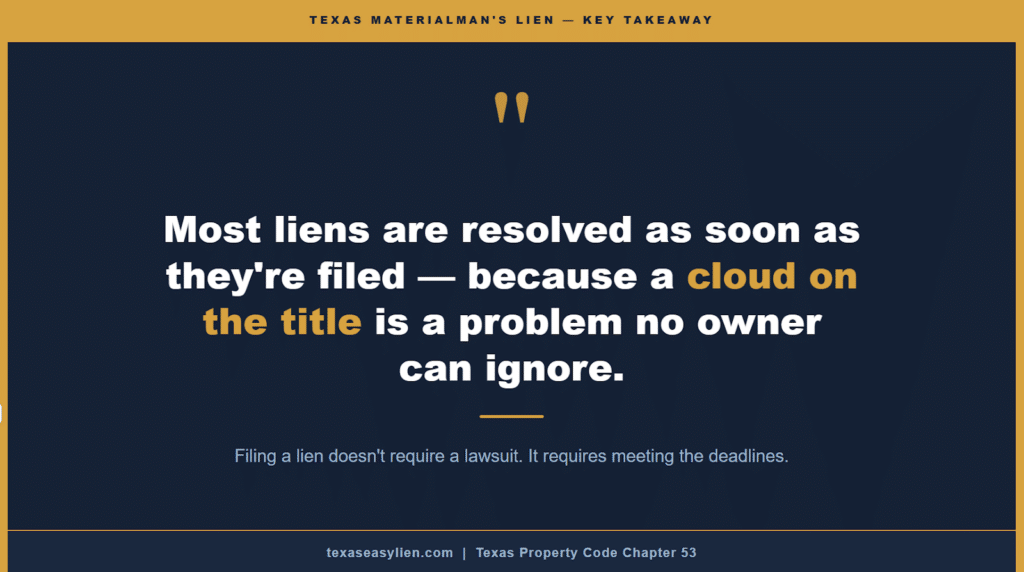
The Texas materialman’s lien is one of the most effective legal protections available to contractors and suppliers in Texas. It doesn’t require expensive litigation to be effective. Most liens are resolved as soon as they’re filed, simply because a cloud on the title creates a problem the property owner cannot ignore. But this protection only works if you use it correctly and on time.
The process has strict deadlines, prescribed notice language, and specific document requirements. Getting one step wrong can mean losing thousands of dollars in unpaid work with no legal recourse.
Texas Easy Lien makes the entire process straightforward. Whether you need to send a Notice of Claim, file a lien affidavit, or release a lien once you’ve been paid, the platform walks you through every step in plain language, handles notarization online, and files electronically with the county clerk, all without hiring an attorney. When you’re ready to protect your payment rights, get started today.