Yes, a contractor can put a lien on your house in Texas, but the law places strict limits on when and how this can happen.
- Texas homesteads have some of the strongest lien protections in the country, requiring written contracts signed by both spouses and filed with the county before work begins.
- For non-homestead properties, even a verbal agreement may be enough for a contractor to file a valid lien.
- Subcontractors you never hired can sometimes place liens on your property if your general contractor fails to pay them.
Know your rights: Many liens filed against Texas homes are invalid because contractors fail to follow the required legal steps.
The short answer to whether a contractor can put a lien on your house is yes. However, Texas construction law creates exceptions that protect homeowners, especially when the property is your primary residence.
Before you panic about that notice in the mail, take a breath. Texas has some of the most homeowner-friendly lien laws in the country. Contractors must meet specific legal requirements before a lien becomes valid and enforceable. Many contractors fail to follow these requirements, which means the lien they filed may not hold up in court.
This guide will walk you through everything you need to know about contractor liens on houses in Texas, from who can file them to what you can do if you find yourself facing one.
What Is a Contractor Lien on a House?
A contractor lien, also called a mechanic’s lien or construction lien, is a legal claim against your property. When a contractor, subcontractor, or materials supplier performs work or provides materials for your home and does not get paid, they can file this claim with the county clerk’s office.
The lien creates what is called a “cloud” on your property’s title. This cloud makes it extremely difficult to sell your home, refinance your mortgage, or take out a home equity loan until the debt is resolved.
You might have paid your general contractor in full, but if that contractor failed to pay a subcontractor or supplier, that unpaid party can still file a lien against your house. The law allows them to pursue the property itself, not just the person who hired them.
Can a Contractor File a Lien on Your House Without a Contract?
The answer depends heavily on what type of property you own and your relationship with the contractor.
When Verbal Agreements May Be Enough
For most commercial properties and non-homestead residential properties, Texas does not require a written contract for valid lien rights. A verbal agreement or even an implied contract based on the work performed can be sufficient.
Say you own a rental property and hire someone to fix the roof based on a handshake deal. If you do not pay, that roofer can likely file a valid contractor lien against the property. The same applies to investment properties, vacation homes, and apartment buildings.
The Texas Property Code allows original contractors (those with a direct relationship with the property owner) to file what is known as a constitutional lien, which does not require prior written agreement or notice. This protection is built directly into the Texas Constitution to ensure tradespeople get paid for their work.
When Written Contracts Are Required
The rules change when talking about your homestead, which is your primary residence. Texas law requires much stricter documentation to protect families from losing their homes over construction disputes.
For a contractor lien without a contract to be invalid on your homestead, you need to understand what protections already exist. The law essentially says: no proper paperwork, no valid lien on your home.

How Does Texas Protect Homestead Properties from Liens?
Texas takes homestead protection seriously. Under Article 16, Section 50 of the Texas Constitution, it is extremely difficult for contractors to attach a valid lien to your primary residence without jumping through several legal hoops.

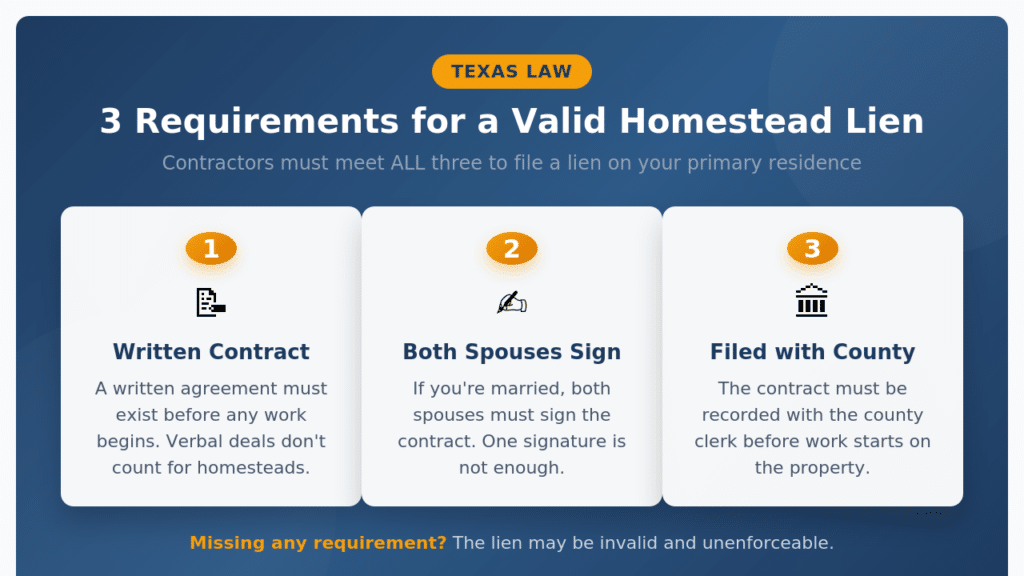
For a lien to be valid on a Texas homestead, the following requirements must be met:
- Written Contract Requirement: The contractor must have a written contract with you before any work begins. Verbal agreements do not count for homestead properties. If someone starts work on your home based only on a conversation, they may have given up their right to file a lien.
- Spousal Signature Requirement: If you are married, both spouses must sign the contract. This rule exists because Texas considers the homestead a family asset, and both spouses must agree to encumber it. A contract signed by only one spouse may be voidable.
- County Recording Requirement: The written contract must be filed with the county clerk in the county where your home is located before work begins. Many contractors skip this step, not realizing it is required. If the contract was not recorded, the lien rights may be compromised.
These requirements apply to all parties in the construction chain. If your general contractor did not file the contract with the county, even the subcontractors working under that contractor may lose their ability to file valid Texas liens against your house.
What Are Common Scenarios That Lead to a Home Lien in Texas?
Understanding how homeowners typically end up with liens on their property can help you avoid these situations or recognize when a lien might be invalid.
Scenario One: The Disappearing Contractor
You hire a general contractor to renovate your kitchen. The work gets done, you pay the contractor the full amount, and everyone seems happy. Three months later, you receive a notice that a plumbing subcontractor has filed a lien on your house. Turns out, your contractor took your money but never paid the plumber.
This situation happens more often than you might think. The subcontractor has a legitimate grievance since they did the work and deserve payment. The question is whether they followed all the proper notice requirements to preserve their lien rights against your property.
Scenario Two: The Quality Dispute
Your contractor finishes a project, but the work is substandard. Maybe the paint is peeling, the flooring is uneven, or the electrical work fails inspection. You withhold final payment until the issues are fixed. Instead of correcting the problems, the worker files a contractor lien on your house to force payment.
This is a legitimate dispute, and both parties may have valid claims. However, the contractor must still follow all legal requirements for the lien to be enforceable.
Scenario Three: The Surprise Bill
A contractor completes additional work that you never authorized then files a lien when you refuse to pay for work you did not request. Change orders and scope creep cause endless construction disputes. Documentation matters enormously in these situations.
Who Can File a Lien on Your House in Texas?
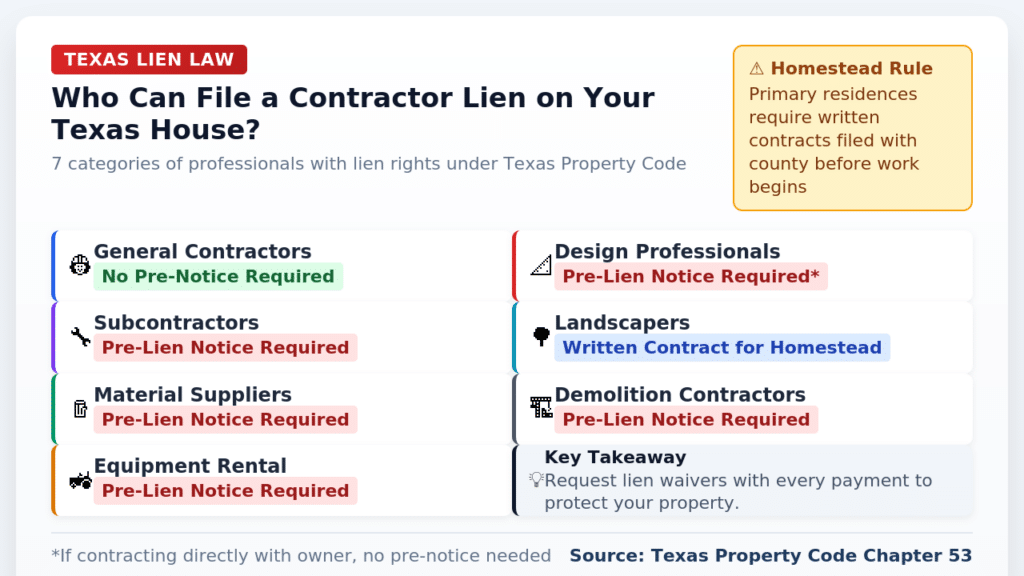
Texas law allows several categories of construction professionals to file mechanic’s liens. Understanding who has this right helps you know what paperwork and protections might apply.
- General Contractors: Those with direct contracts with property owners have the broadest lien rights and typically do not need to send preliminary notices before filing.
- Subcontractors: Companies or individuals hired by the general contractor must send pre-lien notices before they can file a Texas lien on a house. First-tier subcontractors work directly with the GC, while second-tier contractors work for subcontractors.
- Materials Suppliers: Companies that provide building materials, lumber, fixtures, or other supplies for construction projects can file liens if not paid, following the same notice requirements as subcontractors.
- Equipment Rental Companies: Those who rent construction equipment like excavators, scaffolding, or generators have lien rights for unpaid rentals.
- Design Professionals: Licensed architects, engineers, and surveyors can file liens for unpaid design work, even if construction never begins.
- Landscapers: Those providing landscape installation, including irrigation systems, retaining walls, and plantings, have lien rights but must have written contracts for homestead properties.
- Demolition Contractors: Companies that provide demolition services prior to new construction can also file liens for unpaid work.
How Does a Home Lien Affect Your Property in Texas?
A contractor lien on your house creates real problems that extend far beyond the immediate dispute. Understanding these impacts helps you appreciate why quickly resolving liens matters.
Selling Your Home Becomes Complicated: Title companies will not issue clear title insurance with an outstanding lien. Potential buyers can’t get mortgages, and cash buyers will likely demand a price reduction. Most sales simply can’t close until the lien is resolved.
Refinancing Gets Blocked: Lenders require a clear title before issuing new mortgages or home equity loans. A home lien in Texas will stop your refinance application in its tracks until you either pay the lien, negotiate a settlement, or successfully challenge its validity.
Your Credit May Suffer: While the lien itself does not appear on your credit report, the underlying debt might if the contractor also files a lawsuit. Additionally, if the dispute prevents you from refinancing or forces you to sell under unfavorable terms, the financial stress can ripple through your finances.
Interest and Costs Accumulate: Many contractors add interest charges or attorney fees to the original claim. The longer a lien sits unresolved, the more expensive it becomes to clear.
What Can Homeowners Do When Facing a Contractor Lien?
Finding out someone filed a lien on your home is stressful, but you have options. The path you choose depends on whether the lien is valid and the amount in dispute.
Verify the Lien’s Validity: Start by checking whether the contractor followed all required steps. Was there a written contract filed with the county before work began? Did the contractor send proper notices? Were all deadlines met? Courts strictly enforce these requirements, and many liens fail on technical grounds.
Request Documentation: Ask the contractor for copies of contracts, invoices, and proof of work performed. Compare documents against your own records. Discrepancies in square footage, work descriptions, or amounts can indicate problems with the lien.
Negotiate a Resolution: Even when a contractor has a valid claim, negotiation often produces better outcomes than litigation. Consider whether partial payment, payment over time, or additional warranty work might resolve the dispute. The contractor likely wants to get paid and move on just as much as you want the lien gone.
Demand a Release After Payment: Once you pay a valid claim, Texas law requires the contractor to file a lien release within 10 days of receiving your written request. This document officially removes the cloud from your title.
Challenge Invalid Liens: If you believe the lien is fraudulent or improperly filed, Texas law provides remedies. You can send a formal demand for release, file a lawsuit to remove the lien, and potentially recover attorney fees and damages from contractors who file improper liens.
What Are Common Mistakes Homeowners Make with Contractor Liens?
Avoiding these errors can save you time, money, and stress when dealing with construction projects and potential liens.
Paying the Contractor Without Getting Lien Waivers: Always request lien waivers from your general contractor and all subcontractors as a condition of each payment. These documents confirm that everyone has been paid for work through that date and waives their right to file liens for that amount.
Not Withholding Retainage: Texas law allows you to hold back 10% of the contract price during construction and for 30 days after completion. This retained amount creates a buffer to pay any claims from unpaid subcontractors.
Ignoring Pre-Lien Notices: When you receive a notice that a subcontractor or supplier has not been paid, do not brush it off. This notice is a warning that you should withhold funds from your general contractor to cover that claim.
Assuming the Contractor Is Wrong: Sometimes the lien is valid, and the homeowner genuinely owes money. Approaching the situation with hostility rather than an open mind can make negotiations more difficult and expensive.
Waiting Too Long to Act: Liens do not disappear on their own. While contractors have limited time to enforce liens through foreclosure, leaving a lien unresolved creates ongoing problems for your property.
Frequently Asked Questions About Contractor Liens on Houses in Texas
Can a subcontractor I never hired put a lien on my house?
Yes, subcontractors and suppliers who were not paid by your general contractor can file liens against your property, even though you never had a direct relationship with them. Requesting lien waivers with each payment to your contractor is important. However, these subcontractors must send you proper pre-lien notices before their liens become valid.
How long does a contractor have to file a lien in Texas?
The deadline depends on the contractor type and project. Original contractors generally have until the 15th day of the fourth month after work completion for commercial projects, or the 15th day of the third month for residential projects. Subcontractors have shorter windows and must send preliminary notices first. Missing these deadlines invalidates the lien.
Can I sell my house with a lien on it?
Technically, yes, but practically, it is very difficult. Most buyers require a clear title, and lenders will not issue mortgages on properties with outstanding liens. You would typically need to pay off the lien at closing from your proceeds, negotiate a settlement, or successfully have the lien removed before closing.
What happens if I ignore a contractor lien on my house?
Ignoring a lien does not make it disappear. The contractor has one year to file a lawsuit to foreclose on the lien. If they win, the court can order your property sold to satisfy the debt. Additionally, the unresolved lien will block any attempt to sell or refinance until it is addressed.
Can I file a lawsuit against a contractor who files a fraudulent lien?
Yes. Texas law allows homeowners to sue contractors who file improper or fraudulent liens. If you win, you may recover your attorney fees and potentially additional damages. However, you should consult with an attorney to evaluate whether the lien is truly invalid before pursuing legal action.
Protect Your Property and Understand Your Rights
Dealing with a contractor lien on your house is never fun, but Texas law provides protections for homeowners who understand their rights. The strict requirements for homestead liens mean that many contractor claims fail to meet legal standards.
Whether you are a homeowner trying to understand your options or a contractor looking to protect your payment rights the legal way, having the right information makes all the difference. For contractors who need to file proper lien documents that meet Texas legal requirements, Texas Easy Lien provides an affordable, user-friendly platform that handles the complex paperwork. Contact Texas Easy Lien today.